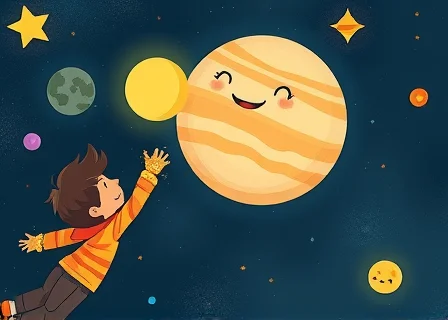
The Boy Who Played Catch with Jupiter's Moons
# The Boy Who Played Catch with Jupiter's Moons
Once upon a time, in a small village nestled between whispering mountains and a silver lake, lived a boy named Orion. Orion was no ordinary child. While other children played with wooden balls and hoops, Orion spent his nights gazing at the stars, dreaming of worlds beyond the blue dome above.
One crisp autumn evening, as Orion sat on his rooftop with his favorite leather mitt, something extraordinary happened. Jupiter, the giant of the night sky, seemed to shimmer brighter than ever before. Four tiny specks danced around it—Io, Europa, Ganymede, and Callisto, the great planet's faithful moons.
"Would you like to play catch?" a voice boomed from the heavens, warm as honey and deep as thunder.
Orion's heart skipped. "With whom?"
"With us, of course!" giggled Europa, the icy moon, her voice tinkling like frozen bells.
Before Orion could respond, a small, glowing orb descended from the sky, leaving a trail of stardust in its wake. It landed softly in his outstretched hand, warm and pulsing with gentle light.
"We've watched you," said Io, the fiery moon, spinning excitedly. "You throw your ball with such hope, such longing. We thought you might like to play with something more... substantial."
And so began the most magical game the universe had ever witnessed.
Orion threw Europa high into the night. She soared past clouds that parted like curtains, beyond birds that slept mid-flight, until she reached the edge of the world and came arcing back, leaving a trail of frost that sparkled like diamonds.
Ganymede, the largest moon, was more challenging. When Orion tossed him upward, he created his own gravity, orbiting briefly around the church steeple before returning to the boy's mitt with a satisfying thump.
"Again! Again!" called Callisto, the most distant moon, who preferred long throws that took her nearly to the horizon before she remembered her promise to return.
They played for hours, or perhaps years—time behaves strangely when moons are involved. The villagers below slept peacefully, dreaming of silver balls and shooting stars, unaware that above their rooftops, a boy and celestial bodies were engaged in the most magnificent game of catch imaginable.
Jupiter watched proudly from his throne among the stars, his Great Red Eye twinkling with amusement. "My moons have found a friend," he rumbled contentedly.
But all games must end, even magical ones. As dawn approached, painting the sky in shades of rose and gold, the moons began to ascend.
"We must return," said Europa softly, resting one last time in Orion's mitt. "Our planet misses us."
"Will you come back?" Orion asked, his voice barely above a whisper.
"Whenever a child looks up with wonder in their eyes," promised Ganymede, "whenever a heart dreams of the impossible, we'll be there. And if you throw your ball high enough, with enough belief, perhaps we'll catch it again."
The four moons rose together, forming a perfect line before rejoining their orbit around the giant planet. Orion watched until they disappeared into the morning light, his mitt still warm with starlight.
Years passed, and Orion grew tall and wise. He became an astronomer, studying the very moons he once played with. Some say he discovered secrets about Jupiter's companions that no telescope could reveal. Others claim that on clear nights, when the sky is dark and the world is quiet, you can still see the moons play, waiting for another believer to throw their ball toward the stars.
And if you listen very carefully on such nights, you might hear the distant giggle of Europa, calling out, "Again! Again!"