The Forest That Was the Earth's Breath
# The Forest That Was the Earth's Breath
Long ago, before mountains learned their names and rivers forgot where they began, there existed a forest unlike any other. This was no ordinary woodland of bark and leaf, but the very breath of the Earth itself, made visible and alive.
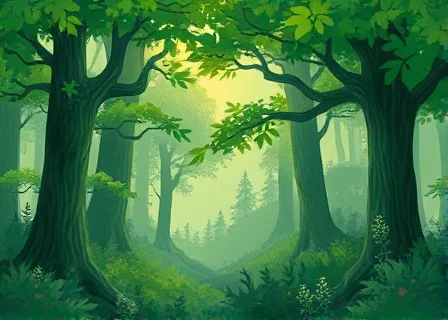
The forest appeared only at dawn, when the world between sleep and waking hung delicate as spider silk. Its trees were not wood but columns of mist, swirling emerald and gold, rising from the soil like exhalations from a dreaming giant. The leaves were whispers—thousands upon thousands of them—rustling with secrets the Earth had kept since time began.
In a village nestled in the valley below, there lived a young girl named Elara who could hear things others could not. While other children played, she sat quietly, listening to the wind speak through grass blades and the stones murmur about the weight of rain. Her grandmother told her she had the listening heart, the rare gift of understanding what the world was saying.
One morning, Elara awoke before the sun and climbed the hill above her village. There, she saw it: the breathing forest, pulsing gently as if the planet itself had lungs. She stepped closer, and the mist parted like curtains.
"Welcome," said a voice that was not a voice but the feeling of roots growing deep. "We have been waiting for one who listens."
Elara learned that the forest was the Earth's way of speaking to those who might understand. Each tree held a memory: the first rain that fell on barren rock, the moment flowers discovered color, the sorrow of glaciers retreating, the joy of seeds finding soil. The forest breathed these stories into the air, and if one listened truly, they could hear the history of everything.
But the forest was fading. Generation by generation, people had stopped listening. They built walls of noise—machines that roared, cities that never slept, voices that spoke but never heard. The Earth's breath grew shallow. The mist-thinned trees flickered like dying candles.
"Why show me this?" Elara asked, her small hands reaching toward a branch that dissolved into fog at her touch.
"Because you are young," the forest replied, "and young hearts remember what old ones forget. The Earth does not need more speakers. It needs listeners."
Elara returned to her village and began to teach. She led children to quiet places where they could hear beetles walking under leaves and water negotiating with stones. She showed adults how to sit without speaking, to let silence fill the spaces where worry had lived. Slowly, people remembered. They planted gardens not for food but for conversation with growing things. They built quiet corners in their homes where they simply listened to the house settling, the wind visiting, the Earth breathing.
And as people listened, the forest grew stronger. Its mist-trees thickened. Its whispering leaves multiplied. The Earth's breath deepened, and the forest became permanent, no longer fading at noon but standing eternal between the visible and the understood.
To this day, the forest exists wherever people remember to listen. It grows in the pause between words, in the silence after rain, in the moment when you stop speaking and realize the world has been talking to you all along.
The Earth still breathes. The question is: are you listening?