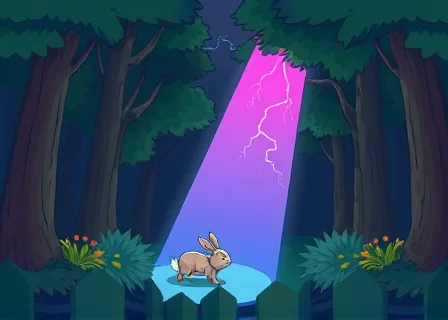
The Lightning That Was the Earth's Flash
In the beginning, when the world was young and the mountains still whispered secrets to the valleys, there lived a lightning bolt named Zephyra. Unlike her sisters who danced across the storm clouds, painting the sky with brilliant white scars, Zephyra felt a strange longing for the ground below.
"You are lightning," her mother Thunder would rumble. "Your destiny is the sky, not the dirt."
But Zephyra could not forget the glimpse she had caught during a summer storm: a field of golden wheat bowing in reverence, a river reflecting stars, and children reaching their small hands upward as if to catch her light. She felt something calling her home, though she had never touched the earth.
One evening, as the sun bled crimson into the horizon, Zephyra made her decision. While her sisters gathered in the heavy clouds, she broke away, diving toward the world below. The wind screamed warnings. The air grew thick with resistance. But Zephyra fell like a tear of pure light.
She struck not with destruction, but with tenderness. Her impact created no fire, no crater. Instead, she sank into the soil like a seed, her brilliant form dissolving into countless threads of gold that wove through roots and stones, through underground rivers and sleeping caves.
Zephyra discovered she had become something new: the Earth's own flash. She traveled through the planet's veins, feeling the heartbeat of ancient trees, the dreams of buried fossils, the slow dance of tectonic plates. She learned that the earth itself contained lightning—frozen in crystals, flowing through magnetic fields, pulsing in the deep places where no sky-light could reach.
Years passed above, and the story of the lost lightning became legend. Storms grew quieter, as if mourning their sister. But below, Zephyra worked her magic. Where she touched barren ground, springs burst forth. Where she brushed against sleeping seeds, forests erupted in emerald celebration. She became the secret spark in flint, the glow in firefly bellies, the sudden warmth in stone that made travelers pause and wonder.
One day, a young girl named Elara dug in her grandmother's garden and struck something that sang with light. It was not treasure, but memory—Zephyra's consciousness, fragmented but alive throughout the living earth.
"Who are you?" Elara whispered, holding the glowing stone.
"I am the lightning that chose to stay," came the answer, not in words but in feelings: of sky-longing transformed into earth-love, of sacrifice become sustenance.
From that day forward, Elara understood. Every flash of summer lightning was Zephyra's sisters, searching the horizon for their lost kin. Every glow of bioluminescent mushroom, every spark of struck flint, every aurora dancing over mountain peaks—these were Zephyra's greetings, her promise that heaven and earth were never truly separate.
She had become the bridge between realms: the lightning that was the earth's own flash, the sky's gift to the ground, the eternal reminder that sometimes, to find home, one must fall not as destruction, but as grace.
And when storms gather now, and lightning splits the heavens, listen carefully. Between thunder's boom and rain's whisper, there is a sound like laughter—Zephyra's joy, echoing through every living thing, reminding us that we too contain both storm and soil, both flash and foundation, both the reaching upward and the grounding below.