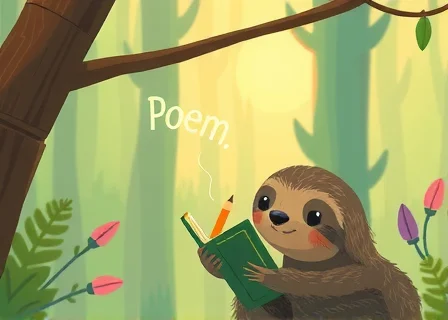
The Sloth Who Was the World's Greatest Poet
# The Sloth Who Was the World's Greatest Poet
Deep in the emerald heart of the Amazon rainforest, where sunlight filtered through the canopy in golden shards and the air hummed with the songs of invisible birds, lived a sloth named Soleno. While other sloths spent their days in peaceful slumber, hanging from branches like fuzzy green ornaments, Soleno did something extraordinary: he wrote poetry.
It began on a morning when a particularly beautiful raindrop traced a path down his fur and landed on a broad leaf below, creating a perfect circular splash. Something stirred in Soleno's slow heart. He felt words forming, not in the hurried way of monkeys or the loud calls of parrots, but in gentle rhythms that matched his deliberate movements.
"Each drop a universe," he whispered to himself, "falling from sky to earth, carrying stories of clouds."
The other animals laughed. "You're a sloth!" chattered the capuchin monkeys. "Sloths don't write poetry. Sloths sleep and eat and move slowly. That is the way of things."
But Soleno continued. He composed verses on broad leaves using berry juice, crafting stanzas about the moon's reflection in forest pools, about the secret conversations between roots beneath the soil, about the courage of seedlings breaking through darkness. His poems moved with the patience of growing trees, each word chosen with the care of a hummingbird selecting nectar.
Word spread through the forest. A jaguar, fierce and proud, heard whispers of the poetry-writing sloth and came to mock him. But as Soleno recited verses about the beauty hidden in the jaguar's fierce eyes, about the loneliness that comes with being the strongest, the great cat fell silent. Tears, rare as diamond dew, filled the jaguar's amber eyes.
"Your words," the jaguar breathed, "they speak the truth I carry but cannot express."
Soon, animals from throughout the rainforest gathered beneath Soleno's branch. Toucans perched quietly, their colorful beaks still for once. Even the chattering monkeys sat transfixed. Soleno spoke of their world in ways they had never heard—poems that captured the sweetness of ripe mango, the terror of storms, the comfort of home.
But Soleno's fame reached beyond the forest. A young girl from a nearby village, herself a lover of words, ventured into the green depths and found the poet sloth. She listened as he composed a verse about the bridge between human and animal worlds, about the shared wonder beneath different skins.
She became his scribe, carefully copying his leaf-poems into notebooks that she carried back to the human world. Soleno's verses traveled to distant cities, printed in books that people held with reverent hands. Critics called him "the world's greatest poet," marveling at the wisdom that came from one who moved slowly enough to truly see the world.
Soleno never left his branch. He didn't need to. He understood what faster creatures missed: that poetry isn't about rushing to capture moments, but about dwelling deeply within them until they reveal their secret songs.
And so the sloth who was the world's greatest poet continued hanging from his tree, writing verses on leaves, reminding all who heard that the most profound truths come to those who move slowly enough to listen.