The Solar System's Great Hide and Seek
# The Solar System's Great Hide and Seek
Long ago, before humans gazed up at the twinkling night sky with wonder, the planets of our solar system were not distant worlds of rock and gas, but lively celestial beings who danced around their warm, glowing mother, the Sun.
One cosmic evening, as the stars began their nightly vigil, Mercury, the swiftest of all the planets, proposed a game. "Let us play hide and seek!" he chimed, his silvery surface sparkling with excitement. "The greatest game the universe has ever seen!"
The planets erupted in joyful agreement. Venus, cloaked in her thick, cloudy dress, volunteered to seek first. "Close my eyes I shall," she promised, turning her face away as she counted to one hundred thousand, her voice echoing through the vacuum of space.
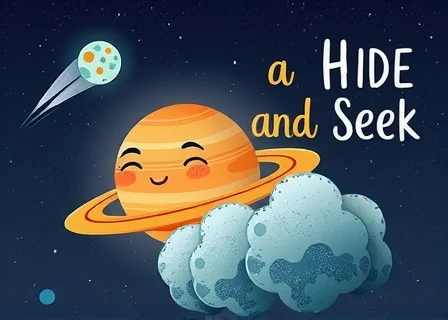
Mercury, being the smallest and quickest, darted behind the Sun, peeking out from behind its blazing corona. Mars, with his rusty red armor, nestled himself among the asteroid belt, hoping the rocky debris would mask his distinctive color. Jupiter, enormous and majestic, found himself in quite a predicament—how does one hide the largest planet in the solar system? With great effort, he positioned himself behind Saturn, whose magnificent rings made for an excellent camouflage.
Saturn, meanwhile, was rather pleased to be useful, though he worried his rings might give them away. Uranus tilted on his side as always, rolled himself into the shadowy outskirts, while Neptune, deep blue and mysterious, simply drifted into the darkness beyond, where he was nearly invisible.
Pluto, though small and no longer considered a proper planet, begged to join. "Please, please!" he pleaded. The larger planets, kind-hearted as they were, allowed him to hide alongside Mercury behind the Sun.
When Venus opened her pearly eyes, she began her search. "Ready or not, here I come!" she called out, her voice rippling through the cosmos.
She found Mercury first—his quick movements had made him dizzy, and he had accidentally bumped into a solar flare. "Too hot, too hot!" he squeaked, darting away. Pluto tumbled out from behind the Sun as well, giggling uncontrollably.
Venus then spotted Mars easily; his red glow stood out like a ruby among gray stones. "Found you, little warrior!" she laughed.
Jupiter and Saturn proved trickier, but Venus noticed the stars bending strangely around them—gravity's telltale sign. "There you are, my giant friends!"
Uranus and Neptune took the longest to find. Venus searched the dark corners of the solar system until she heard Uranus humming to himself. Neptune remained hidden for an entire Earth year, but eventually, his own icy winds gave him away.
The game ended with all the planets gathered together, laughing and spinning in their orbits. The Sun, who had been watching all along with a warm smile, pulsed gently with pride.
From that day forward, whenever children on Earth look up at the night sky and wonder why the planets seem to move and dance, they are actually remembering that great cosmic game, still playing hide and seek among the stars, forever young and full of magic.