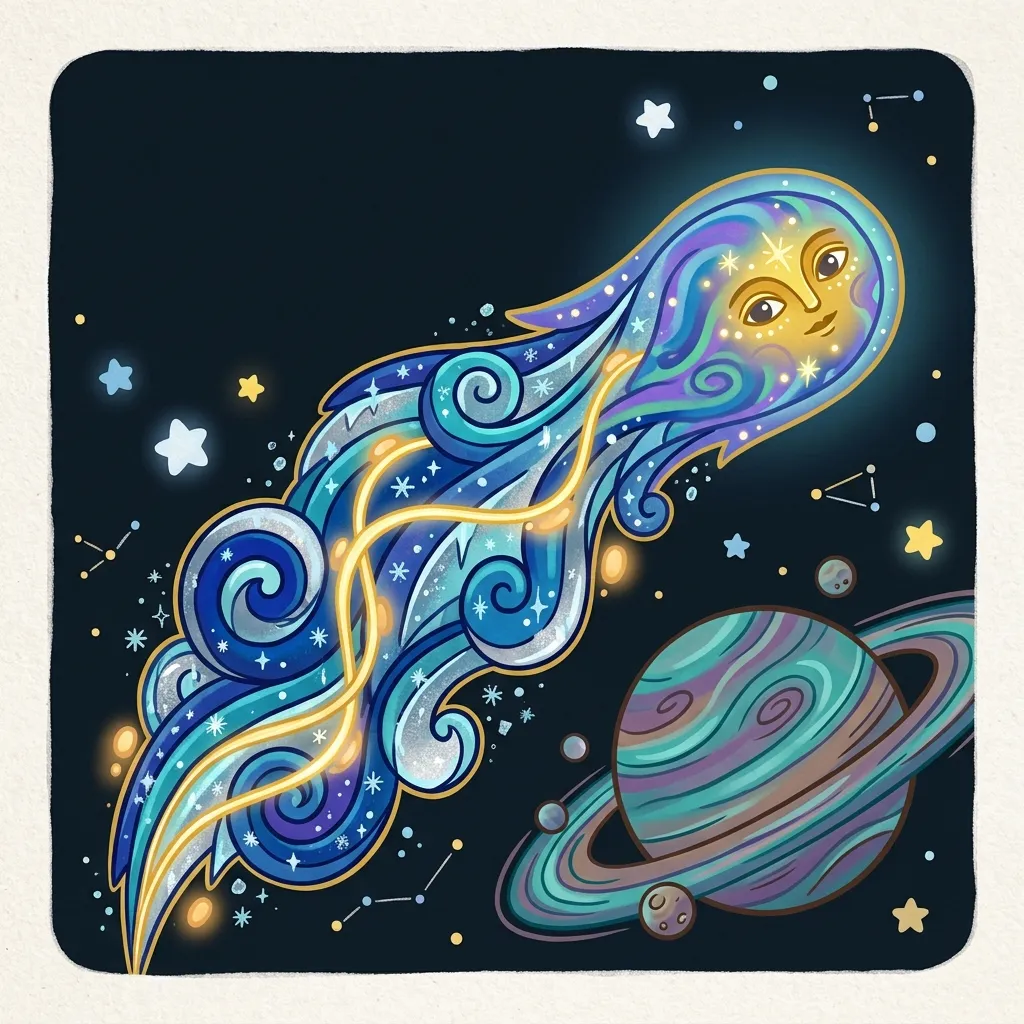
The Sunbeam on a Comet's Tail
Once upon a time, in the velvet corridors of the cosmos, there lived a sunbeam named Elara who was unlike any light the heavens had ever known. While her siblings were content to spill golden across quiet planets and warm the faces of sleeping flowers, Elara dreamed of motion. She dreamed of riding the silver tail of a comet and dancing through the dark.
The other sunbeams laughed in their shimmering way. Comets were wild things, born of ice and ancient dust, and their tails stretched for millions of leagues through the freezing void. No sunbeam had ever caught one, let alone held on. But Elara listened to the old star-whales who sang of celestial highways, and she studied the paths of wandering meteorites, learning the rhythms of the sky.
One evening, when the galaxy breathed slow and the nebulae curled like drowsy cats, a great comet appeared. Its name was Kaelith, and it came from the cold beyond the last known constellation. Kaelith's head was a mountain of frozen sapphire, and its tail streamed behind like a river of diamond dust, crackling with the music of a thousand crystal bells.
Elara gathered herself into the brightest point she could become, and she leapt.
She fell through the dark, a needle of pure gold, and struck the comet's tail just as it curved past the rings of an ancient gas giant. The impact rang like a bell. For a moment, she clung to ice crystals no larger than tears, and the cold tried to unmake her. But she remembered what the star-whales had taught her: light is not warmth alone; light is also song.
So Elara sang. She sang the song of the first dawn, when the universe opened its eyes and saw itself for the first time. She sang of oceans catching morning and forests waking beneath a gentle sky. The comet listened. The ice crystals along its tail began to glow, and the cold loosened its grip.
Together they traveled. They passed worlds where creatures with six eyes watched the sky and whispered omens. They slipped between the rings of a planet that had been turning for a billion years, and Elara saw her own reflection in the ice, stretched long and luminous like a promise. She learned the comet's language, which was the language of orbits and long patience, and Kaelith learned hers, which was the language of warmth and sudden joy.
Seasons do not exist in the deep sky, but time still moves, and eventually Kaelith began to slow. The comet's great arc was bending back toward the outer dark, where the suns are only distant stars and the cold is absolute. Elara felt the frost creeping into her edges. She knew she could not stay.
Before they parted, Kaelith spoke in the slow voice of ice. You have made my tail a road of light, the comet said. Wherever I travel now, something of the sun will follow.
Elara understood. She poured herself into the comet's dust, not as a prisoner of the cold, but as a gift. She became a thread of gold woven through silver, a warmth that would never fade. And when Kaelith returned to the inner system years later, people on a small blue world looked up and gasped, for the comet's tail was no longer pale. It burned with a gentle fire, the color of honey and hope.
They called it the brightest comet they had ever seen. Children made wishes upon it that came true more often than not, though no one could say why. Old lovers walked beneath its arc and remembered things they had forgotten. And in villages where the windows faced east, people noticed that on certain mornings, when the air was still and the dew lay thick on the grass, a single beam of sunlight would linger on a windowsill longer than it should, as if it were listening.
Elara never returned to the family of sunbeams who had laughed at her. She did not need to. She had found what she was looking for: a way to be both still and moving, both warm and wild. She rode the comet through eternity, a sunbeam on a comet's tail, and every time Kaelith passed close to the sun, she flared a little brighter, as if to say: I am still here. I am still singing. And if you look up on a clear night, when the sky is dark and your heart is open, you might just see her: a golden thread in the silver dark, proof that even the smallest light can change the shape of the heavens.