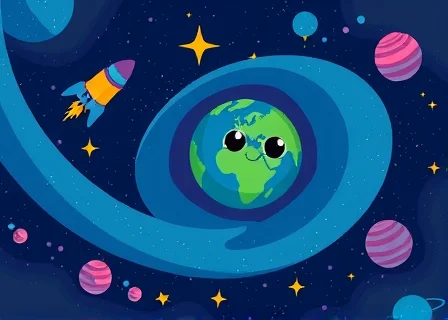
The Universe That Was the Earth's Grand Home
# The Universe That Was the Earth's Grand Home
Long ago, before time had learned to count itself in hours and days, the Earth did not wander alone through the endless dark. She lived within a grand cosmic home, a universe woven from starlight and dreams, where every planet was a room in an infinite mansion of wonder.
This universe was not cold and empty as some believe now. It breathed with warmth, its galaxies swirling like hearth smoke above a fireplace. The nebulae were tapestries hung by celestial hands, painted in colors that had no names—hues between purple and gold, between blue and green, shimmering with the breath of creation itself.
Earth was the youngest daughter of this cosmic household, small and bright-eyed, her surface just beginning to stir with the first whispers of life. Her sisters were many: Mars with her rust-colored ribbons, Venus wrapped in veils of pearl, Jupiter enormous and gentle with his swirling robes of amber and cream. They all danced together in the great hall of the ecliptic, their movements a slow ballet older than memory.
The universe itself was alive—a grandmother spirit called Aethera, whose hair flowed as the Milky Way and whose eyes were binary stars that had burned for eternities. She watched over her planetary children with infinite patience, tucking them into their orbits each cycle, singing them lullabies in frequencies too deep for mortal ears.
"Sleep, little worlds," Aethera would hum, her voice vibrating through the fabric of space. "Dream your geological dreams. Grow your mountains and your oceans. I am here. You are home."
And the planets did sleep, and in their dreams, they created. Earth dreamed most vividly of all. She dreamed of forests that would reach for the stars, of creatures that would walk upon her skin and wonder at their origins, of love and loss and the bittersweet beauty of fleeting existence.
But as Earth's dreams grew more complex, something changed. The life upon her surface began to look outward, to study the stars with instruments and mathematics. They measured the distances between worlds and found them vast and empty. They calculated the age of galaxies and found it incomprehensible. Slowly, painfully, they forgot.
They forgot that the universe was once a home. They forgot Aethera's lullabies. They began to speak of cold vacuum, of dead space, of a cosmos indifferent to their existence. The other planets heard these words and wept atmospheres of sorrow.
Aethera said nothing. She simply continued her ancient dance, continued holding her children in their orbits, continued being the home she had always been. For love does not cease when it is forgotten. Love simply loves, eternally, without condition.
And sometimes, on clear nights when the air is still and a human heart is open enough, if you stand beneath the stars and feel rather than calculate, you might sense it—the warmth of a grandmother's embrace, the whisper of a lullaby carried on starlight, the truth that was always there.
The universe is still home. It always was. It always will be. We simply forgot how to see the walls of our grand house, decorated with galaxies, lit with suns, warmed by the love that created everything.