The Wind That Was the Earth's Song
# The Wind That Was the Earth's Song
Long ago, before the mountains learned their names and the rivers forgot their sources, the Earth was silent. Not the peaceful quiet of a sleeping meadow, but a deep and lonely silence that stretched across valleys and plains like an invisible blanket. The people walked softly, afraid to make noise, for they believed sound was a theft from the universe—a taking without giving back.
In a small village nestled between two ancient hills lived a girl named Elara. She was different from the others. Where they whispered, she hummed. Where they crept, she danced with feet that tapped gentle rhythms against the soil. The elders warned her repeatedly: "Hush, child! The Earth does not give us permission to fill her air with noise."
But Elara could not help herself. Something inside her begged to be released, like a bird trapped behind her ribs, beating its wings against the cage of her heart.
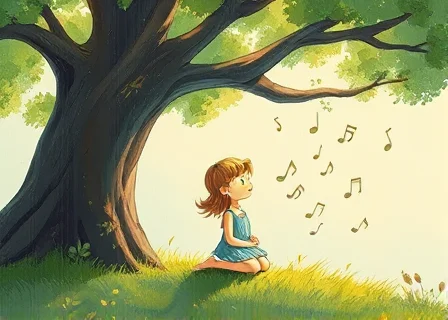
One autumn evening, when the sky blazed orange and purple like a painter's fever dream, Elara climbed to the highest hill above her village. The wind was still that day, and the silence pressed down so heavily she could feel it in her bones. She closed her eyes and opened her mouth, and for the first time in her life, she sang.
It was not a song anyone had taught her. The melody rose from somewhere deeper than memory, older than language. It was the sound of roots reaching for water, of seeds cracking open in darkness, of leaves turning their faces toward the sun. Her voice carried across the valley, fragile and trembling, and then something miraculous happened.
The wind answered.
It began as a whisper through the tall grass, then grew into a chorus that swept through the trees, rustling every leaf, shaking every branch. The wind wrapped around Elara's song and carried it further than she ever could have alone—over mountains, across oceans, into the ears of every living thing.
The villagers below stared in wonder as the hills seemed to sing back. They had believed the Earth was silent because they had never listened properly. But now they understood: the Earth had been waiting. Waiting for someone brave enough to sing first.
From that day forward, the people learned that sound was not theft but gift. When you sang to the Earth, she sang back. The wind became her voice, carrying songs from village to village, from generation to generation. Mothers sang lullabies that the wind softened into whispers. Lovers sang promises that the wind delivered across impossible distances. Farmers sang gratitude for rain, and the wind carried their thanks into the clouds.
Elara grew old, but her voice never weakened. When she finally died, the people feared the songs would end. But on the morning after her burial, they woke to find the wind humming through their eaves, through the cracks in their doors, through the very marrow of their bones.
The Earth had learned their songs, and now she remembered them for them. The wind was no longer just air in motion—it was the Earth's own voice, singing back every melody ever given to her, mixing them into something vast and eternal.
And if you climb a high hill on a quiet day and listen carefully, you can still hear it: the wind that was, and always will be, the Earth's song.