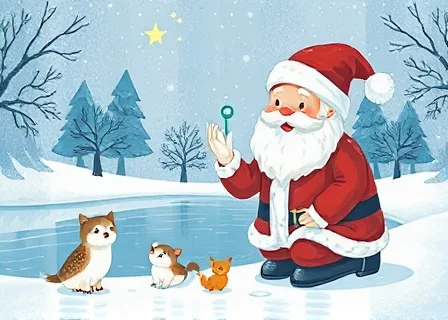
How Santa Lost the Key to Winter
Once upon a time, in the crystalline heart of the North Pole, there stood a palace carved entirely from aurora light and ancient frost. Within its deepest vault, beneath layers of enchanted ice that shimmered like captured starlight, rested a small silver key—no larger than a robin's feather—that held dominion over all of winter itself. This was the Winter Key, forged by the first snowfall at the dawn of the world, and Santa Claus had guarded it faithfully for centuries.
But on a particularly frigid December evening, just three weeks before Christmas Eve, the key vanished.
Santa discovered its absence when he went to wind the Great Frost Clock, a magnificent timepiece whose ticking regulated the snowfall across every continent. The ornate keyhole stood empty. The velvet cushion where the key had rested for generations bore nothing but a faint, mischievous glitter—the telltale mark of fairy magic.
"Bother," Santa muttered, adjusting his spectacles. "Not again."
He summoned his head elf, a sharp-eyed woman named Figwort with ears like folded birch leaves. Together, they retraced the night's events: a delivery of gingerbread to the Frost Giants, a diplomatic visit from Jack Frost himself, and—ah, there it was—a knock at the servant's entrance just after midnight, when Santa had briefly stepped away to stoke the hearth.
"A child had come," Figwort remembered, her voice tightening. "Or something wearing a child's shadow. Small, wrapped in a coat too large, asking for a glass of milk."
Santa's beard drooped. "And I left the vault door ajar when I went to fetch it."
The trail led them beyond the workshops and candy-cane borders, into the Whispering Woods where the ancient pines kept secrets older than language. Here, the snow fell upward in places, and the air tasted of peppermint and old memories. They followed the glitter—always that faint, infuriating glitter—deeper into the forest.
They crossed the Bridge of Borrowed Wishes, where travelers left their hopes suspended on silver threads. They forded the River of Almost-Tomorrow, whose icy waters ran backward on Tuesdays. Finally, at the edge of a frozen lake that reflected not the sky but the dreams of sleeping children, they found the thief.
She was a winter sprite, no taller than Santa's boot, with hair like hoarfrost and eyes that shifted between amber and blue. The Key floated above her open palms, spinning lazily, and around her gathered dozens of creatures: hares with coats of diamond frost, owls whose feathers chimed like bells, and foxes whose tails left trails of snowflakes.
"I didn't steal it," she said before Santa could speak. "I borrowed it. The lake is dying. See?"
She gestured to the ice beneath them, and Santa—truly looked. The lake's heart was dark. The enchanted cold that sustained it was fading, and with it, the dreams it held in trust. Without this lake, children across the northern lands would wake with empty hearts, unable to imagine, unable to believe.
Santa studied the sprite's worried face, the gathered animals, the darkening ice. He thought of rules and tradition and the Great Frost Clock still unwound. Then he thought of why winter existed in the first place—not to control the cold, but to protect the quiet magic that only darkness could nurture.
"Well," Santa said gently, kneeling until his eyes met hers. "I suppose the Key was never meant to sit in a vault. It was meant to serve."
The sprite's eyes widened. "You'll let me keep it?"
Santa smiled, and his beard caught the starlight. "I'll let you borrow it. Every winter. But you must promise to wind the clock yourself, on Christmas Eve, when all the world is watching."
She nodded solemnly, and the Key settled into her palms like a sleeping bird. The lake's heart began to glow once more, silver and steady, and the creatures scattered into the trees, their joy falling like fresh snow.
And from that year forward, children would sometimes wake to find their windows decorated with frost patterns that looked suspiciously like tiny keys—and on particularly magical mornings, the snow would arrive exactly when hope needed it most.