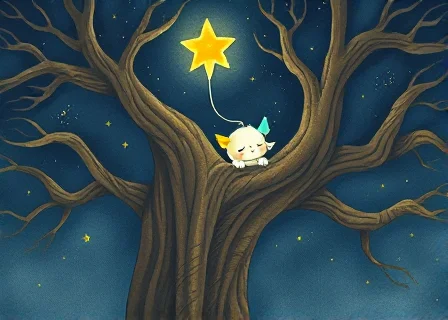
Lullaby for a Tiny Stargazer
In the velvet folds of the Whispering Woods, where fireflies danced in silver spirals and mushrooms hummed ancient melodies, there lived a tiny creature named Pippin. He was no ordinary woodland being—Pippin was born with wings made of starlight, translucent and shimmering, and eyes that held the depth of midnight skies.
While other forest folk slept beneath canopies of leaves, Pippin perched on the highest branch of the Elder Oak, gazing upward at the tapestry of heavens above. He knew the name of every constellation. He could trace the path of comets before they blazed across the darkness. He listened to the music of distant planets, a symphony only he could hear.
But Pippin had a secret sorrow. Each night, as the moon climbed higher, he watched a single star flicker uncertainly in the eastern sky—a small, lonely light that pulsed like a frightened heartbeat. It was growing dimmer with each passing evening, and Pippin knew that when a star's light went out completely, it fell from the sky and was lost forever.
"I must help it," he whispered to the wind.
The wind, wise and ancient, replied, "Then you must sing the Lullaby of the Cosmos, the song that mothers all the stars to sleep. But no creature of the earth has ever known its melody."
Undeterred, Pippin set out on a journey through the Whispering Woods. He climbed over the Crystal Stream, where waters ran with liquid moonlight, and crossed the Bridge of Sighs, woven from spider silk and morning dew. He sought the Oracle of Owls, who dwelled in the hollow of the oldest tree.
"Wise one," Pippin called into the darkness, "teach me the Lullaby of the Cosmos."
The great owl opened one amber eye. "The lullaby is not learned, little stargazer. It is felt. You must gather the ingredients of comfort: the warmth of a sleeping fox's den, the gentle rhythm of a mother bear's breathing, the softness of dandelion wishes, and the silence between two falling leaves."
And so Pippin searched. He pressed his tiny hands against the warm earth above a red fox's burrow and felt the steady dreams beneath. He sat beside a slumbering bear cub and matched his breath to its mother's. He caught dandelion seeds in his palms as they floated on evening air. And on the stillest night, he stood in a meadow and listened—truly listened—until he heard the impossible pause between leaves descending to earth.
When he had gathered all these things within his heart, Pippin returned to the Elder Oak. He spread his starlight wings wide, closed his luminous eyes, and began to sing.
His voice was barely louder than a whisper, yet it carried upward through the atmosphere, through the clouds, through the thin cold veil where earth meets sky. It was a melody woven from warmth and rhythm and softness and peace.
The flickering star steadied. Its light strengthened, glowing soft and golden. And as Pippin sang, he watched it pulse in time with his lullaby, no longer afraid, no longer fading.
Then the star sang back—a single clear note that drifted down like snow, wrapping around Pippin like a blanket. He felt his eyelids grow heavy, his wings grow still, and there, on the highest branch of the Elder Oak, the tiny stargazer fell asleep beneath a sky of grateful stars, each one humming his melody back to him.