The Adventures of the Blue Mailbox
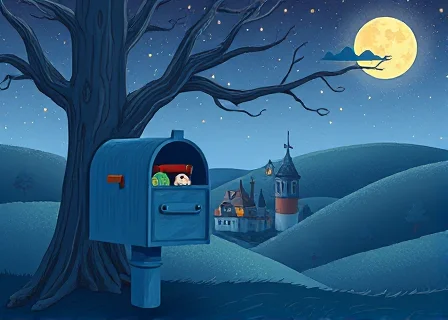
In a quiet village nestled between emerald hills, there stood a blue mailbox at the edge of Willow Lane. It was no ordinary mailbox—its paint shimmered like the twilight sky, and on still nights, it hummed a soft, silver melody that only the wind could hear.
The villagers called him Barnaby, though no one remembered who had named him or why. He had simply appeared one spring morning, planted firmly beside the old oak tree, waiting patiently for letters that never came.
But Barnaby was not just a mailbox. He was a keeper of secrets, a guardian of unspoken wishes, and on the night of the first full moon after the winter solstice, he awoke.
His hinges creaked as he stretched his metal lid toward the stars. "It's time," he whispered to himself, for he knew what the old tales foretold: every hundred years, the blue mailbox could walk the earth and grant three wishes to those pure of heart.
With a wobble and a clang, Barnaby hopped off his post and began his journey down Willow Lane.
His first stop was the cottage of little Elsie, who sat by her window crying into a crumpled piece of paper. Barnaby peeked inside and saw a letter addressed to her father, who had sailed across the great sea and never returned.
"Dear Elsie," he whispered through the glass. She looked up, eyes wide. The mailbox hopped onto her windowsill and opened his lid invitingly. Trembling, she placed the letter inside. Barnaby closed his lid, spun three times, and *poof*—the letter vanished in a cloud of sapphire sparkles.
By dawn, a ship appeared on the horizon. By noon, Elsie's father stood at her door, older but smiling, with stories of storms and starlight and how a blue mailbox in his dreams had guided him home.
Barnaby's second wish came at dusk, in the meadow where old Thomas sat alone, feeding the crows. He had been a baker once, but his hands shook now, and the village had forgotten his bread.
"I wish I could bake one last perfect loaf," Thomas murmured, though he thought no one listened.
But Barnaby listened. He hopped into the meadow, opened his lid wide, and Thomas placed his weathered hands inside. A warmth spread through him, steady and golden. The next morning, Thomas baked the most magnificent loaf the village had ever tasted—crusty and soft, fragrant with rosemary and hope.
One wish remained.
Barnaby wandered to the hilltop where the moon seemed close enough to touch. He thought of all the letters he'd held, all the words people had trusted him with. He thought of Elsie's joy and Thomas's smile, and he knew what he must do.
"I wish," he whispered to the moon, "that everyone in this village remembers how to speak from their hearts."
The moon blinked, and a beam of light struck Barnaby square in the chest. His blue paint flared like a beacon, and a ripple of warmth spread across the hills and into every home.
From that night on, the villagers wrote letters again—not just to those far away, but to each other. They wrote love notes and apologies, dreams and doodles, and Barnaby held them all, standing proudly by the old oak tree.
He never walked again, but sometimes, on still nights, if you press your ear to his painted side, you can hear him humming—a soft, silver melody, full of wishes waiting to be heard.