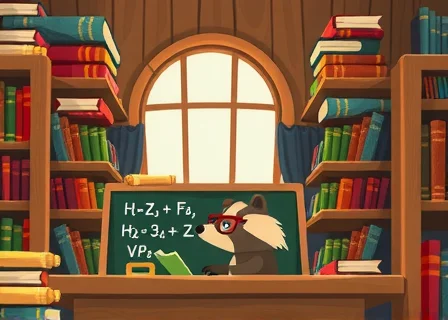
The Badger Who Was a Master of Logic
# The Badger Who Was a Master of Logic
Deep in the heart of Whispering Woods, where moonlight filtered through ancient oaks like silver honey, there lived a badger named Barnaby. Unlike other badgers who spent their nights digging and foraging, Barnaby spent his time arranging pebbles in precise patterns and drawing elaborate diagrams in the soft forest floor with a stick.
Barnaby was a master of logic.
While other creatures relied on instinct and intuition, Barnaby believed in premises, conclusions, and the elegant dance of syllogisms. His burrow was not cluttered with roots and twigs but organized shelves of bark tablets, each inscribed with careful reasoning about everything from mushroom growth patterns to the migration schedules of geese.
"The world makes sense if one thinks properly," Barnaby would say, adjusting his spectacles made from polished quartz and spider silk.
One autumn evening, a terrible commotion erupted in Whispering Woods. The Moonberry, a magical fruit that glowed with captured starlight and kept the forest's magic alive, had vanished from its sacred grove. Panic spread like wildfire. Without the Moonberry, the woods would lose their enchantment, and the creatures would be ordinary animals, vulnerable to the harsh world beyond.
The forest council gathered in desperation. The owl claimed she saw shadows moving westward. The rabbit insisted he heard rustling from the east. The fox argued passionately for both directions simultaneously, which helped no one.
Barnaby arrived late, carrying his satchel of reasoning tools. "Emotions cloud judgment," he announced. "We require systematic analysis."
The creatures groaned. They wanted action, not arguments.
But the elder stag, whose antlers bore the weight of countless winters, nodded gravely. "Let us hear the badger's logic."
Barnaby began. "Premise one: The Moonberry glows with starlight. Premise two: Only creatures of the night can approach it without burning their paws. Conclusion: We seek a nocturnal thief."
The animals murmured agreement.
"Premise three," Barnaby continued, drawing in the dirt, "The grove's thorns remain unbroken. Premise four: Large creatures break thorns. Conclusion: The thief was small."
More nodding. The fox looked uncomfortable.
"Premise five: The berry's glow was seen moving toward the creek at midnight. Premise six: Only aquatic creatures travel comfortably between water and land at that hour." Barnaby's eyes gleamed. "Therefore, we seek a small, nocturnal, water-dwelling creature."
The council turned as one toward the otter family, who had recently moved upstream. The otters, terrified, confessed nothing but agreed to lead them to their cousin, the water vole, who had been acting suspiciously.
Confronted with Barnaby's impeccable reasoning, the vole broke down. He had stolen the Moonberry to light his newborn kits' nursery, not understanding its importance to the forest.
The berry was returned, magic restored, and the vole's family received glowing moss as a compromise.
"Logic," Barnaby said that evening, arranging his pebbles once more, "is simply kindness applied to thinking."
And in Whispering Woods, where reason and magic proved not opposites but allies, the creatures learned that sometimes the most enchanting thing of all was a well-constructed argument.