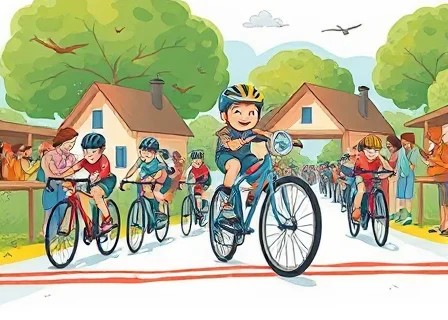
The Bicycle Who Dreamed of Racing
Once upon a time, in a small village nestled between emerald hills and whispering pine forests, there lived a little blue bicycle named Pip. Pip was unlike any other bicycle in the village. While the other bicycles were content to lean against the garden wall, rusting quietly in the sun, Pip spent every night gazing at the racetrack that wound along the hillside, where the village champion held his grand races each spring.
"You're just a bicycle," the old tricycle would creak, shaking his three wheels in disapproval. "Bicycles don't race. Bicycles are ridden. There's a difference."
But Pip didn't believe him. Every evening, as the village children settled into bed and the moon painted silver trails across the cobblestones, Pip would close his eyes and dream. He dreamed of wind rushing through his spokes, of the ground blurring beneath his tires, of cheering crowds and the thrilling crack of a starting pistol. In his dreams, he didn't just carry riders — he flew.
The other bicycles laughed at him. "Look at Pip, dreaming again!" they would call out. "What will you race on? Dreams and starlight?"
Pip would say nothing. He simply kept dreaming, night after night, until the village children noticed something peculiar. Whenever little Tommy tried to ride him, Pip felt lighter, faster, as if he were pushing forward with a will of his own. Tommy would arrive at school breathless and wide-eyed, swearing that the bicycle had carried him there in half the usual time.
One crisp morning, a terrible commotion broke out in the village square. The champion's prized racing bicycle had suffered a snapped chain and a cracked frame just hours before the grand race. The village was in despair. The race would have to be cancelled.
Pip's heart hammered against his handlebars. This was his moment.
He wiggled his kickstand free and rolled forward into the square, his blue paint gleaming in the morning light. "I'll race," he said in a voice so small it was almost a bell ring.
The villagers stared. The champion laughed, then stopped when he saw the determination in Pip's polished headlight. "You? A common bicycle?"
"I may be common," Pip replied, "but I have been training every night in my dreams. And dreams are more powerful than you think."
Something in his voice convinced the champion. With a shrug, he climbed onto Pip's seat, and together they rolled toward the starting line. The other competitors sneered, their carbon frames gleaming with arrogance.
The pistol cracked.
What happened next would be told in the village for generations. Pip didn't just ride — he soared. His wheels barely seemed to touch the ground. The champion clung to his handlebars, wide-eyed and breathless, as Pip overtook one racer after another. The wind sang through his spokes just as he had always dreamed. When Pip crossed the finish line, a full wheel-length ahead of the nearest competitor, the village erupted in cheers.
From that day forward, Pip was no longer called a common bicycle. He was called the Dreaming Racer, and children throughout the village learned a most important lesson: even the humblest heart can achieve the grandest dreams, if only it dares to believe.
And every night, Pip still dreams — but now, his dreams are memories, and his memories are magic.