The Boy Who Built a Cardboard Rocket
In a small village nestled between whispering pines and rolling meadows, there lived a boy named Elian who collected cardboard boxes the way other children collected stamps or shiny stones. His room overflowed with them—flattened delivery boxes, shoe boxes with faded labels, cereal boxes stacked like towers of a fragile kingdom. The other children called him peculiar, but Elian knew a secret they didn't: cardboard wasn't just cardboard. If you listened closely, it hummed with possibilities.
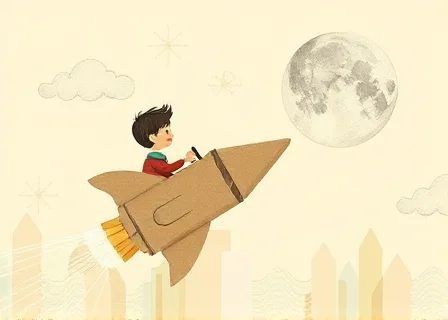
One evening, when the sky bruised purple with twilight and the first stars blinked awake like drowsy owls, Elian decided he would build a rocket. Not a plastic rocket, not a wooden rocket, but one made entirely of cardboard, bound together with paste he cooked from flour and water, and sealed with the wax from a hundred birthday candles. He worked through the night, his small hands pressing flaps together, smoothing seams with the edge of a wooden spoon. The rocket grew taller than he was, a slender cylinder with a cone-shaped nose and fins cut from refrigerator boxes. It smelled of wheat and honey and childhood determination.
When he finished, Elian climbed inside through a door he'd hinged with ribbon and hope. He closed his eyes and whispered, "Take me to the stars." Nothing happened. He whispered again, louder this time. Still nothing. He sighed, leaned his head against the cardboard wall, and heard a sound he'd never noticed before—a faint, rhythmic thumping, like a heartbeat. The rocket was alive.
With a shudder that rattled his teeth, the cardboard rocket lifted from the ground. Elian peered through a window he'd cut from wax paper and watched his village shrink to a speck, then a memory, then nothing at all. Clouds rushed past like galloping horses. The air grew thin and cold, but the cardboard held warm, wrapping him in the comfort of a thousand shipped packages.
When the rocket finally landed, it did so with a soft sigh, settling on a surface that glittered like crushed sugar. Elian opened the door and stepped out onto a moon made entirely of silver thread, spun by spiders who wore tiny crowns and spoke in voices like wind chimes. They welcomed him without surprise, as if they'd been expecting a boy in a cardboard rocket all along.
"Weave with us," they said, and handed him a needle made from a wish.
Elian stayed on the thread-moon for what felt like both an instant and an eternity. He learned to spin stories from silver filament, to tie knots that held entire galaxies, to stitch constellations into blankets that kept dreamers warm. When he finally returned home, descending through the atmosphere in a rocket that smelled faintly of stardust and flour, he found that only a single night had passed.
But Elian was different. His fingers carried the memory of celestial weaving, and his eyes held the depth of woven space. He never stopped building things from cardboard, and every rocket, every castle, every impossible invention hummed with the same quiet magic—the magic of a boy who believed that ordinary things could carry you to extraordinary places, if only you asked them nicely enough.