The Boy Who Caught the Music of the Spheres
# The Boy Who Caught the Music of the Spheres
Once upon a time, in a village nestled between whispering mountains and a sea that sang against the shore, there lived a boy named Elian. From the moment he could walk, Elian heard something no one else could hear—a distant, celestial melody that drifted down from the stars above.
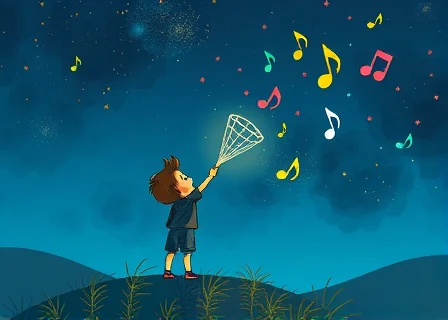
While other children played with wooden toys and chased chickens through the dirt lanes, Elian would climb to the highest hill and stretch his arms toward the heavens, trying to catch the invisible notes that danced on the wind. The villagers called him "the dreamer" and shook their heads with gentle pity.
"Music of the spheres," they would say. "Only fools and madmen claim to hear such things."
But Elian knew what he heard. It was a symphony older than time itself—the song of planets turning in their orbits, of moons pulling at tides, of stars burning their ancient fires in the velvet dark. Each celestial body contributed its own voice: Jupiter's deep bass rumble, Venus's crystalline soprano, Saturn's resonant rings humming like a cosmic harp.
On his twelfth birthday, Elian made a decision. He would catch this music and preserve it, so others might hear the beauty that filled his days and nights. With careful hands, he wove a net from silver spider silk he had collected from moonlit gardens, threading it with dewdrops gathered at the exact moment dawn broke over the eastern hills.
For seven nights, Elian climbed his hill and cast his net toward the stars. For seven nights, he caught nothing but air and disappointment. The villagers began to whisper more loudly, their doubts cutting sharper than thorns.
On the eighth night, something changed. The moon hung full and heavy, painting the world in shades of silver and shadow. Elian felt the music swelling, growing stronger than ever before. He cast his net with all his might, and this time, he felt resistance—a trembling, singing weight that pulled against the delicate threads.
The stars themselves seemed to lean toward him. Constellations shifted their ancient patterns. The net glowed with captured starlight, and within its meshes, the music of the spheres thrummed like a living thing.
Elian carefully lowered his net to earth, and the moment the silver strands touched soil, the music burst forth in a cascade of sound so beautiful that the entire village woke from their sleep. They came running, drawn by a melody that spoke to something deep within their souls—the rhythm of their own hearts, the pulse of the blood in their veins, the connection between earth and sky that they had forgotten.
The village elder, a woman whose hair flowed white as winter frost, listened with tears streaming down her weathered cheeks. "I remember now," she whispered. "My grandmother told me of this music. She said our ancestors once danced to it, before we learned to stop listening."
From that day forward, Elian became the keeper of the celestial song. Each night, he would release a portion of the music to drift over the village, and the people found themselves living differently. They treated each other with more kindness, worked with more joy, and dreamed with more wonder.
And Elian learned that catching the music was only the beginning—the true magic lay in sharing it, in allowing the song of the spheres to remind every heart of its own celestial origin, of its connection to the vast and singing universe that cradled them all.