The Bridge Built by Forgiveness
# The Bridge Built by Forgiveness
Once upon a time, in a valley cradled between two ancient mountains, there stood two villages separated by a roaring river. On the eastern bank lived the Lumina folk, whose homes glowed with lantern-light even at noon. On the western bank dwelled the Umbra people, whose dwellings were carved from shadowstone and cooled by gentle darkness.
For generations, the two villages had been enemies. The Lumina believed the Umbra had stolen their moonstones centuries ago. The Umbra claimed the Lumina had poisoned the river's source. No one remembered the truth anymore, only the anger that had been passed down like an unwanted inheritance.
The river raged between them, wild and uncrossable. Many had tried to build bridges. The Lumina constructed one of golden light, but it shattered when the Umbra's children threw stones at it. The Umbra fashioned one of dark crystal, but the Lumina's elders sang it into dust. Each failure deepened the hatred, and the river grew wider with every tear that fell into its waters.
One winter, a terrible sickness came to the valley. It did not discriminate between light and shadow—it stole the warmth from Lumina babes and the breath from Umbra elders alike. The villages watched their loved ones fade, helpless and alone.
In the Lumina village lived a young woman named Elara, whose sister lay fevered and dying. In the Umbra village lived a boy named Kael, whose grandmother could no longer rise from her bed. Both carried the same desperate hope in their hearts.
On the coldest night of the year, Elara came to the riverbank with lantern in hand. Kael arrived from the opposite shore with a staff of shadowwood. They saw each other across the churning water, not as enemies, but as fellow sufferers.
"I would trade all my light to save her," Elara called out, her voice breaking.
"I would surrender all my shadows to heal him," Kael replied.
Something shifted in the air between them. Elara raised her lantern, not as a weapon, but as an offering. Kael lifted his staff, not in defense, but in welcome. And then Elara did the unthinkable: she stepped toward the water and whispered, "I forgive you."
Kael's eyes widened. "But we have done nothing to you."
"Your ancestors may have," she said, "but you have not. And I choose to release what I did not suffer."
Kael stepped forward as well. "Then I forgive you too. For every wrong I was taught to remember."
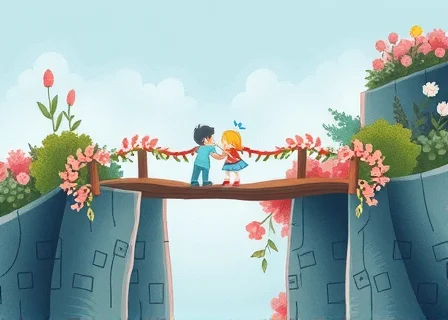
As these words left their lips, something miraculous began to form. From Elara's lantern streamed threads of golden light. From Kael's staff flowed ribbons of silver shadow. They met above the river, weaving together into something neither pure light nor pure darkness, but a luminous twilight that hummed with possibility.
The bridge grew beneath their feet, arch by arch, built not of wood or stone but of released grievances and chosen mercy. It sparkled with forgiveness so potent it could heal.
By dawn, the bridge stood complete. The villagers came cautiously from both sides, meeting in the middle where Elara and Kael stood hand in hand. They carried their sick across the bridge, and as they passed over its forgiving surface, the fever broke and the breath returned.
The two villages became one. They learned that the moonstones had been borrowed, not stolen. They discovered the river had been poisoned by neither of them, but by a drought long forgotten.
And the bridge remained, teaching all who crossed that the strongest structures are not built of pride or punishment, but of the courage to forgive first, and the wisdom to meet halfway.