The Christmas Ornament Who Dreamed of Summer
In a dusty corner of an antique shop in a frosty little town, there hung a glass ornament shaped like a sunflower. Her name was Solara, and she was unlike any other decoration on the crooked brass tree where she resided. While her companions gleamed with wintry motifs—silver snowflakes, crystal reindeer, and sapphire icicles—Solara blazed in amber and gold, her painted petals forever reaching toward an imagined sky.
Every December, the shopkeeper would string the ornaments onto the tree, and children would press their rosy noses against the window to admire them. Solara loved Christmas as much as any ornament could, but something stirred restlessly within her painted heart. When she gazed at the snowy street beyond the shop window, she did not see beauty. She saw a world asleep, waiting.
"I want to see summer," she would whisper to the velvet tree skirt below her.
The velvet skirt, old and wise and rather sleepy, would sigh. "You are a Christmas ornament, little sunflower. Summer is not your season."
But Solara dreamed of it still. She dreamed of warm rain and cicada songs, of butterflies landing on her painted petals, of long golden evenings when the sun painted everything the same shade of honey as herself. She dreamed of children running barefoot through green grass instead of stomping through slush in heavy boots.
One midsummer's eve, long after the Christmas season had faded and the shop had closed for the night, something extraordinary happened. A beam of moonlight streamed through the window and struck Solara directly in the center of her glass face. The light was warm—impossibly warm—and she felt a tingling sensation spread through her painted surface.
"You wish to see summer," said the moonbeam in a voice like silver bells. "But summer must also wish to see you. Close your eyes, little one, and wish hard enough that the whole world hears."
Solara closed her painted eyes and wished. She wished not just for herself but for every child who had ever pressed their face to the shop window in July and found it dark and locked. She wished for fireflies and lemonade, for the smell of cut grass and the sound of sprinklers spinning lazily on green lawns.
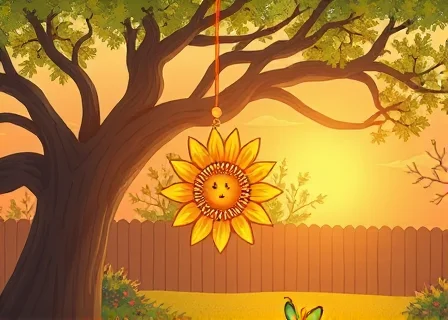
When she opened her eyes, the antique shop had vanished. She hung instead from the low branch of an enormous oak tree in someone's sunlit backyard. A child's laughter rang out. A little girl in a yellow dress ran past with a jar full of fireflies, and a butterfly—actual, real, orange and black butterfly—landed gently on Solara's glass shoulder.
The sun was setting, painting the sky in shades of apricot and rose. Everything was warm. Everything was golden. Everything was exactly as she had dreamed.
But as night fell and the fireflies rose, Solara noticed something. The little girl had hung her from the tree with a bright red ribbon, and beside her, glowing softly in the twilight, hung other ornaments—a snowflake, a reindeer, an icicle—each one brought to life by the same impossible magic.
Solara smiled her painted smile. Summer was beautiful, yes. But she realized, hanging there in the firefly light surrounded by her winter friends, that every season is more magical when shared.