The Cinderella Who Loved Science
# The Cinderella Who Loved Science
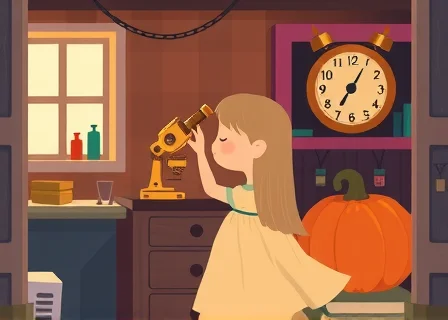
Once upon a time, in a kingdom where magic sparkled in every corner, there lived a young girl named Ella who preferred test tubes to tiaras and microscopes to mirrors. While other children played with enchanted dolls, Ella collected beetles and studied the chemistry of potion-making.
Ella's mother had been a renowned alchemist before she passed away, leaving her daughter a laboratory hidden in the castle's forgotten tower. After her father remarried, Ella found herself relegated to the scullery, scrubbing pots while her stepmother and two stepsisters, Drusilla and Prunella, flaunted their shallow magic at royal balls.
"Science is for commoners," her stepmother would sneer. "A proper lady masters levitation spells, not logarithms."
But Ella disagreed. She believed that understanding how things worked was its own kind of magic.
One evening, as Ella catalogued mushroom spores by candlelight, a peculiar visitor arrived—an elderly woman with eyes that twinkled like distant stars. She wore robes embroidered with constellations, and her staff was topped not with a crystal, but with a glass sphere containing swirling galaxies.
"I am your Scientific Fairy Godmother," the woman announced. "I've watched you, child. You question, you experiment, you seek truth. That is the bravest magic of all."
Ella blinked. "You're not going to turn me into a princess?"
"Heavens, no. Why would I do that? I'm going to help you show the kingdom that science is magnificent."
With a wave of her galaxy-topped staff, the Fairy Godmother transformed Ella's rags into a gown woven from iridescent silk that shifted colors like oil on water. "This fabric demonstrates light refraction," she explained. Upon Ella's feet appeared glass slippers—not enchanted to fit only her, but crafted with such precision that they showcased the molecular structure of silica itself.
"Now," said the Fairy Godmother, "there's a Science Fair at the palace tonight. The Prince is searching not for a bride, but for a brilliant mind to help solve the kingdom's problems—crop blight, polluted wells, medicines that don't work."
Ella's heart raced. "But my stepmother—"
"Will not stop you. Go, and remember: midnight is not when the magic ends, but when the real work begins."
At the palace, Ella amazed the court with demonstrations of germ theory, showing how tiny creatures caused disease. She explained crop rotation using nitrogen-fixing plants. She designed water filtration systems using sand and charcoal.
The Prince, a young man with ink-stained fingers and curious eyes, was enthralled. "Finally," he exclaimed, "someone who understands that progress comes from questioning, not wishing!"
When the clock struck midnight, Ella fled, leaving behind one glass slipper—not because enchantment demanded it, but because she'd dropped it while rushing to her secret laboratory.
The Prince searched the kingdom, not to find whom the slipper fit, but to find its owner. When he reached Ella's home, her stepmother tried to claim the slipper, but it shattered—cheap glass couldn't mimic Ella's precise craftsmanship.
Ella stepped forward, holding the matching pair. "I made these," she said simply.
The Prince smiled. "Then will you help me build a kingdom where science and wonder walk together?"
Ella agreed, not to become a princess, but to become the Royal Scientist. And she lived happily, and curiously, ever after.