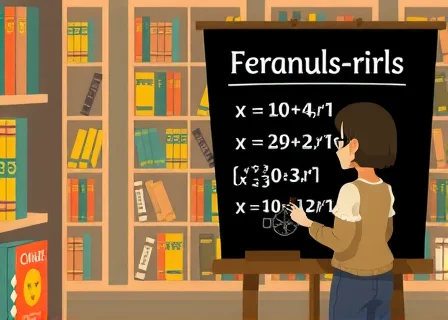
The Cinderella Who Was a Brilliant Mathematician
Once upon a time, in a kingdom where numbers danced like stars and equations bloomed like flowers, there lived a young woman named Cinderella. Unlike the tales you might know, this Cinderella possessed not just kindness, but an extraordinary gift for mathematics that sparkled brighter than any glass slipper.
After her father's passing, Cinderella's wicked stepmother and two jealous sisters forced her into servitude. They made her scrub floors with logarithmic brushes and count endless piles of lentils using prime factorization. "Calculate our taxes!" they demanded. "Balance our accounts!" they ordered. Yet they never understood the beautiful patterns Cinderella saw in everything—the Fibonacci spirals in the castle's rose garden, the geometric perfection of snowflakes, the infinite decimals hidden in teardrops.
While her sisters practiced curtsies, Cinderella studied calculus by candlelight, her fingers tracing integrals in the ashes of the fireplace. The cinders became her chalkboard, and she earned her name not from dirt, but from the mathematical discoveries written in ash.
When the King announced a grand ball to find a bride for his son, Prince Septimus—a scholar who valued wisdom above beauty—the stepmother and sisters gleefully prepared their gowns. "You may come if you solve this riddle," the stepmother sneered, presenting an impossible equation. Cinderella solved it in moments, but they locked her away anyway.
In the garden, where Cinderella had often contemplated theorems among the fireflies, a luminous figure appeared. Her fairy godmother, Dr. Algebrina, wielded not a wand but a golden compass. "Mathematics is magic," she whispered, drawing circles in the air that transformed into a gown woven from Möbius strips, shimmering with impossible geometry.
"But remember," Dr. Algebrina cautioned, "the enchantment lasts until midnight, when the clock strikes twelve and all variables return to their original state."
At the ball, Cinderella captivated not with dance, but with discourse. She discussed number theory with the royal astronomer, debated probability with the treasury minister, and solved the kingdom's century-old tax paradox before dessert. Prince Septimus, who had grown weary of superficial courtship, found himself enchanted by her brilliant mind. They spent the evening deriving elegant proofs together, their laughter echoing like chimes.
But as the clock began its countdown to midnight, Cinderella remembered her godmother's warning. She fled, losing not a slipper, but her notebook filled with revolutionary theorems.
The Prince searched the kingdom, not by fitting feet into glass, but by testing minds with problems from the notebook. When he arrived at Cinderella's house, her sisters failed spectacularly. But Cinderella, called from the kitchen, not only solved each problem but improved the solutions, her equations flowing like poetry.
The Prince recognized her genius immediately. They married in a ceremony where vows were written as mathematical proofs, their love demonstrated as an irrefutable theorem.
Cinderella became the kingdom's greatest mathematician, establishing academies where children learned that numbers held their own magic. Her stepmother and sisters were given positions in the royal accounting office—appropriately humble work that required the arithmetic they'd never bothered to learn.
And they all lived logically ever after, proving that true beauty lies not in appearances, but in the elegant patterns of a brilliant mind.