The City Where Buildings Are Made of Living Trees
# The City Where Buildings Are Made of Living Trees
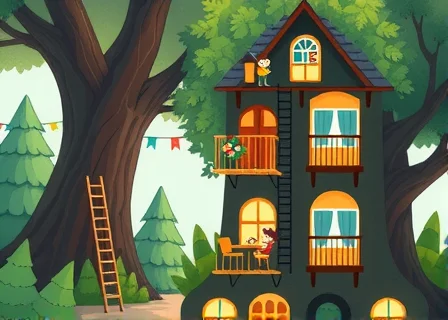
Deep in the heart of the Emerald Forest, hidden from the eyes of ordinary travelers, there existed a city unlike any other. Its towers were not built of stone or steel, but of ancient, living trees whose branches intertwined to form soaring spires that touched the clouds.
This was Arboria, the city of living wood.
Long ago, when the world was young and magic flowed freely through the rivers and winds, a wise druid named Elara discovered this sacred grove. She understood that the great trees possessed consciousness, that they could feel and think and dream. With gentle hands and a heart full of reverence, she learned to communicate with them, to ask rather than command, to grow rather than construct.
The trees, sensing her pure intentions, agreed to shelter her and those who would follow. Over centuries, they shaped themselves into homes, libraries, marketplaces, and temples. Their bark smoothed into walls, their branches wove into archways, and their leaves formed living roofs that changed with the seasons.
In spring, the city bloomed with countless flowers, their fragrance drifting through every room. Children played in courtyards where cherry blossoms rained down like pink snow, and families gathered for meals beneath canopies of fresh green leaves.
Summer brought deep shade and cool breezes. The trees extended their foliage to protect residents from the midday sun, while their roots drew water from underground springs to fountains that sparkled in every square. At night, bioluminescent fungi embedded in the walls cast a soft blue glow, guiding wanderers home.
Autumn transformed Arboria into a masterpiece of amber and gold. The buildings blazed with color, their leaves creating carpets of crimson and copper that crunched beneathfoot. The trees prepared for rest, drawing their energy inward, sharing warmth with those who lived within them.
Winter saw the city wrapped in silence and snow. Bare branches traced intricate patterns against gray skies, while inside, the thick trunks provided insulation against the cold. Families gathered around hearths carved directly into the living wood, where fires crackled harmlessly, fed by fallen branches that the trees willingly shed.
The people of Arboria learned to live in harmony with their surroundings. They never took more than they needed, always asking permission before making changes. Children were taught to listen to the trees' whispers, to understand their moods, to celebrate their growth.
In return, the trees protected their inhabitants. During storms, their branches bent but never broke, shielding the city from wind and rain. When enemies approached, the roots would rise to form barriers, and the branches would tangle into impenetrable walls.
At the center of Arboria stood the Mother Tree, the oldest and largest of them all. Her trunk was wide as a mountain, her branches supporting an entire neighborhood. Within her hollowed heart sat the Council Chamber, where elders from both species—human and tree—gathered to make decisions for the community.
It was said that the Mother Tree remembered everything: every birth, every death, every joy, every sorrow. She held the collective memory of the city, and those who sat quietly within her could hear echoes of centuries past.
Visitors rarely found Arboria, for the forest concealed it from those with greedy hearts. But those who approached with respect and wonder sometimes caught glimpses of living towers through the mist, heard melodies carried on the wind, and knew that magic still existed in the world.
And so the city endured, a testament to what could be achieved when humanity chose cooperation over conquest, when buildings grew instead of being built, when nature and civilization became one and the same.
In Arboria, every wall breathed, every floor had roots, and every home was alive with the gentle pulse of the forest eternal.