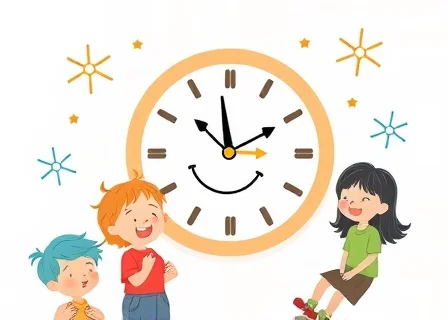
The Clock That Ran on Laughter
Once upon a time, in a village nestled between whispering willows and singing streams, there stood a peculiar clock tower at the heart of the town square. Unlike any other clock in the kingdom, this magnificent timepiece did not run on springs, weights, or gears alone. It ran on laughter.
The clock had been built centuries ago by a whimsical inventor named Grandfather Tickles, who believed that time itself should be joyful. "What good is time," he often said, "if not filled with merriment?" His clock was enchanted with golden gears that spun only when children giggled, silver springs that wound tighter with each belly laugh, and a pendulum that swung to the rhythm of happy hearts.
For generations, the village thrived. The streets echoed with constant chuckles and snickers, for the villagers knew their joy kept time itself moving forward. The clock tower chimed melodious tunes every hour, and its face—painted with a smiling sun—seemed to beam down at everyone who passed beneath.
But one dreary winter, a gloomy sorcerer named Lord Somber moved to the edge of town. He despised happiness and found laughter particularly grating. "Time should be serious!" he declared. "Life is but a march toward inevitability!" With a wave of his dark wand, he cast a spell of solemnity over the village.
Slowly, the laughter faded. Adults grew too busy to play. Children forgot how to skip. Even the baker's chuckle over a burnt loaf turned into a frustrated sigh. The clock began to slow. Its golden gears groaned. The silver springs loosened. The smiling sun's painted expression seemed to droop.
One day, the clock stopped entirely.
Panic spread through the village. Without the clock, days blurred together. Roosters crowed at midnight. Flowers bloomed in snow. Tea grew cold before it could be poured. The villagers gathered in the square, bewildered and frightened.
A little girl named Pip, no older than seven, stepped forward. She remembered what her grandmother had told her: "The clock feeds on laughter, child. Starve it of joy, and time itself grows hungry."
Pip climbed the clock tower stairs, her small feet echoing in the silence. At the top, she examined the great mechanism, now still as stone. Then she did what any wise child would do—she told herself a joke.
"Why did the dragon invite the knight to dinner?" she whispered to the gears. "Because he wanted some well-done company!"
A tiny giggle escaped her lips. Somewhere deep in the clock, a golden gear twitched.
Encouraged, Pip told another joke, then another, until her laughter rang through the tower like bells. The villagers below heard her joy and began to smile. A chuckle rippled through the crowd. Then another. Soon, the entire square erupted in laughter—some at Pip's jokes, some at the sheer absurdity of a child saving time itself.
The clock whirred to life. Gears spun. Springs wound tight. The pendulum swung with renewed vigor. And high above, the painted sun seemed to grin wider than ever before.
Lord Somber, hearing the commotion, peeked from his cottage. The laughter reached him too, and despite himself, a small smile tugged at his lips. The spell broke.
From that day forward, the village made a promise: no matter how dark the times, they would never forget to laugh. For they had learned that joy was not merely a luxury—it was the very mechanism that kept their world turning, tick by tock by tock.
And the clock? It never stopped again.