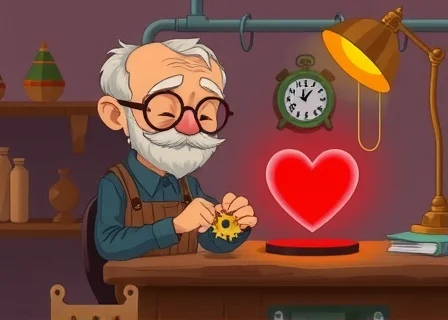
The Clockmaker Who Could Mend Broken Hearts
In a cobblestoned village nestled between whispering woods and silver-capped mountains, there lived an elderly clockmaker named Elias Thorne. His shop, tucked beneath the crooked spire of the old town hall, was filled with timepieces of every description: grand grandfather clocks that chimed like church bells, delicate pocket watches that sparkled like captured stars, and cuckoo clocks whose tiny birds sang forgotten melodies.
But Elias possessed a secret gift that no customer advertised aloud. He could mend broken hearts.
It began on a rain-swept evening when a young woman named Clara entered his shop, her eyes red from weeping, her hands trembling as she clutched a shattered locket. "They say you fix things," she whispered. "Things others cannot."
Elias gestured to his workbench, scattered with gears and springs that gleamed in the candlelight. "I mend clocks, child. Their hearts, if you will."
"Not clocks," Clara said, placing the broken locket before him. Inside was a faded portrait of a soldier who would never return from war. "This."
Elias studied her face, then the locket, then the great astronomical clock behind him, its celestial hands rotating through zodiac signs painted in gold leaf. He understood.
He worked through the night, not on the locket, but on a small mechanism of his own design. By dawn, he had crafted a tiny clockwork bird with wings of rose quartz and eyes of sapphire. When wound, it did not chirp or sing, but played a melody so tender that Clara's tears slowed, then stopped.
"The heart is not a thing to be repaired," Elias told her gently. "It is a thing to be reminded that it still beats."
Word spread through the village like dandelion seeds on summer wind. A baker whose wife had left him arrived with flour still dusting his apron. A child who had lost her beloved dog came clutching a worn collar. A widow brought her husband's stopped pocket watch, wound it for the first time in three years, and listened as its ticking filled the silence she had grown accustomed to.
Elias never claimed magic. He simply listened, worked with his hands, and gave each visitor something to carry forward: a music box that played their favorite lullaby, a wind-up butterfly that fluttered its wings in gentle rhythm, a small clock that chimed not the hours, but moments of gratitude.
Years passed, and Elias grew frailer. The village children, now grown with children of their own, worried about who would help when their hearts broke. On his deathbed, surrounded by those he had comforted, Elias smiled weakly.
"The gift was never mine," he whispered. "I simply reminded you that you already possessed it. Every beat of your heart is a mending. Every breath, a beginning."
When Elias passed, his shop remained, filled with clocks that continued ticking in harmonious chorus. Visitors found no note, no instruction, no successor. But on the workbench sat a single unfinished timepiece, surrounded by tools worn smooth by decades of loving use.
Those who entered broken found themselves drawn to the workbench. They picked up the tools, felt their weight, and somehow knew what to do. Not because of magic, but because they finally understood: the mending had always been within them.
And in the village between the woods and mountains, hearts continued to heal, one gentle tick at a time.