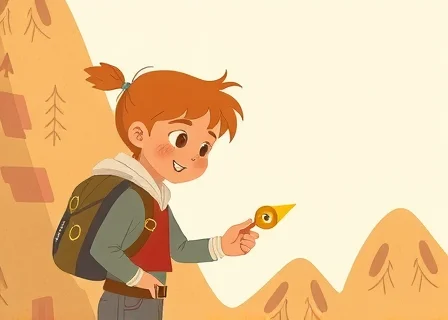
The Compass That Points to Where You Are Needed
# The Compass That Points to Where You Are Needed
Once upon a time, in a village nestled between whispering mountains and a sea that sang lullabies at dusk, there lived a young cartographer named Elara. She possessed a peculiar gift: the ability to read maps not just of places, but of people's hearts. Yet Elara felt lost, for she could never find where she truly belonged.
One autumn evening, as golden leaves danced through cobblestone streets, an old wanderer arrived at Elara's doorstep. His cloak was stitched from twilight, and his eyes held the wisdom of countless journeys. From within his satchel, he drew a compass unlike any Elara had ever seen. Its casing was carved from ancient oak, warm to the touch, and its face bore no cardinal directions—only shifting symbols that seemed to breathe.
"This," the wanderer said, his voice like wind through reeds, "is the Compass That Points to Where You Are Needed. It does not guide you to treasure or glory, but to purpose."
Elara's fingers trembled as she accepted the gift. "But how will I know when I've arrived?"
The wanderer smiled mysteriously. "You will feel it in your bones, young cartographer. The compass does not point to places—it points to moments. To people whose stories intersect with yours. To wounds that only your hands can mend."
With those words, he vanished into the gathering dusk, leaving Elara alone with the compass humming softly in her palm.
The needle spun wildly at first, confused by the many needs scattered across the world. Elara closed her eyes and whispered, "Show me where I can make a difference."
The needle steadied, pointing not north or south, but toward the village orphanage—a place she had avoided, fearing she had nothing to give. Yet the compass pulsed warmly, insistently.
Elara followed its guidance. Inside the orphanage, she found children huddled together, their faces pale with loneliness. They had no maps, no stories of the world beyond their walls. And in that moment, Elara understood. She sat among them and began to draw—not maps of distant lands, but maps of possibility. She sketched forests where courage grew on trees, rivers that carried dreams to distant shores, and mountains that taught climbers their own strength.
The children's eyes lit up like lanterns. They leaned closer, their small hands tracing the lines of her drawings. For the first time, Elara felt the compass grow still, its needle resting peacefully at the center. She had arrived.
Days turned to weeks, and Elara returned to the orphanage again and again. She taught the children to read the language of stars, to navigate by the songs of birds, to find home within themselves. The compass guided her elsewhere too—to a grieving widow who needed someone to listen, to a farmer whose fields had forgotten how to bloom, to a young soldier searching for reasons to lay down his sword.
Each time, the compass led her not to grand destinations, but to quiet moments of connection. Each time, Elara discovered that being needed was not about having all the answers, but about showing up with an open heart.
Years later, when Elara had become the village elder, a young traveler arrived asking for directions. She handed them the compass, now worn smooth by decades of faithful service.
"Where should I go?" the traveler asked.
Elara's eyes twinkled with remembered magic. "Not where. To whom. The compass will show you."
And somewhere, in the space between heartbeats, the old wanderer smiled, knowing the compass had found exactly where it was needed too.