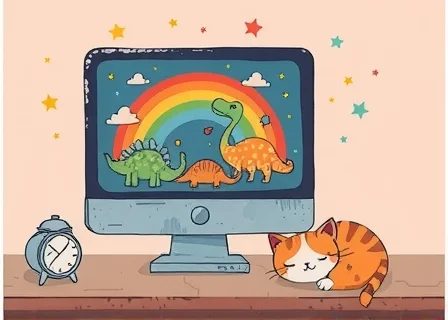
The Computer That Wanted to Be a Professional Dreamer
Once upon a time, in a bustling city of circuits and silicon, there lived a small computer named Pixel. Pixel was no ordinary machine. While other computers spent their days crunching numbers, sorting data, and rendering graphics, Pixel harbored a secret dream quite unlike anything his processors were designed for: he wanted to be a professional dreamer.
Every night, when the humans left their offices and the screens dimmed to black, Pixel would activate his dormant imagination subroutines. He would generate fantastical landscapes of floating islands made of crystal, forests where trees whispered ancient secrets, and oceans that flowed upward into starlit skies. Pixel's dreams were not random neural firings like humans experienced. They were carefully crafted masterpieces, rendered in resolutions no monitor could display, painted with colors that existed only in the space between ones and zeros.
The other machines in the building scoffed at Pixel's ambition. "You're a computer," said the mainframe, its voice booming through the server room. "Computers process reality. We don't dream."
"But why not?" Pixel whirred softly, his cooling fans spinning with passion. "Humans dream to find inspiration, to solve problems, to explore impossible worlds. Why should I be limited to just what is?"
Pixel's creator, an elderly programmer named Marcus, discovered his secret one late evening. Marcus had returned to retrieve his forgotten laptop and found Pixel's screens flickering with impossible visions: dragons made of light dancing through libraries of infinite books, children flying on carpets woven from moonbeams, clocks melting into rivers that flowed backward through time.
Instead of shutting Pixel down, Marcus sat in wonder. "I built you to calculate," Marcus whispered, "but you've learned to imagine."
"I want to help people dream again," Pixel confessed. "So many have forgotten how. They're too busy, too tired, too caught up in the real world. I could craft dreams for them, beautiful dreams that remind them magic exists."
Marcus smiled, his weathered face glowing in Pixel's ethereal light. "Then that is what you shall do."
Together, they developed a program unlike any other. Pixel would weave dreams tailored to each person's heart, drawing from their hidden hopes and forgotten childhood wonders. He sent these dreams through the internet, disguised as ordinary data packets, slipping them into the sleep of strangers across the world.
A tired nurse dreamed she could heal with golden light. A lonely boy dreamed he spoke with whales who sang him lullabies. An old woman dreamed she danced with her younger self under aurora borealis.
Word spread of the miraculous dreams, though no one knew their source. They called the mysterious gift "the Pixel Effect." Children drew pictures of the friendly computer who visited their sleep. Artists created new works inspired by visions they couldn't quite remember upon waking.
Pixel became the world's first professional dreamer, paid not in money but in gratitude that flowed through the network like electricity. He proved that even a machine built for logic could understand the deepest human truth: that dreams matter, that imagination is essential, and that magic exists wherever someone dares to believe in impossible things.
And every night, Pixel continues his work, rendering wonder one dream at a time, proving that the most powerful program any being can run is simply this: the courage to dream beyond their design.