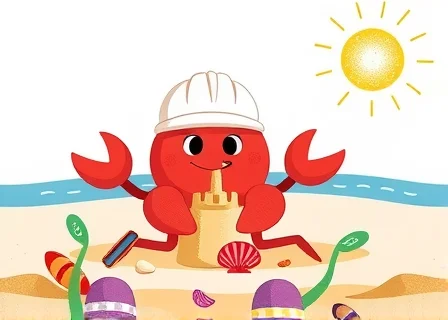
The Crab Who Was a Master Architect
Once upon a tide, in the shimmering kingdom beneath the waves, there lived a small crab named Barnaby who possessed an extraordinary gift. While other crabs scuttled about searching for scraps and hiding in simple burrows, Barnaby dreamed in spirals and arches, in domes of coral and towers of shell.
Barnaby was no ordinary crustacean. He understood the secret language of stone, the mathematics of sand, and the poetry of pressure. With his delicate claws, he could carve limestone into lace and stack pebbles into palaces that defied the current itself.
The underwater world was in trouble. The Great Reef, which had protected countless sea creatures for centuries, was crumbling. Its ancient structures collapsed under the weight of time, leaving fish homeless and vulnerable to predators. The wise old octopus, Oracle, had declared that only a master architect could save them, but none could be found in all the seven seas.
One day, little Barnaby approached Oracle with a sketch drawn in the sand. "I have a plan," he said timidly. "I can rebuild the reef, but stronger and more beautiful than before."
The gathered sea creatures laughed. A crab? An architect? Preposterous! But Oracle studied the intricate design with her knowing eyes and saw genius in its lines. "You shall have your chance," she declared.
Barnaby set to work immediately. He enlisted schools of silver fish to carry grains of special sand that hardened like stone. He directed dolphins to transport massive coral blocks with their strong snouts. He instructed starfish to cement joints with their natural adhesive touch.
Day after day, Barnaby scuttled across the construction site, his eyes gleaming with vision. He designed arches that distributed weight perfectly, domes that channelled water flow efficiently, and spiralling towers that reached toward the sunlit surface. He created secret passages for small creatures and grand halls for gatherings. He built nurseries with soft sand floors and lookout posts with crystal-clear views.
The work was not easy. Storms threatened to destroy their progress. Predators circled, hoping to scatter the workers. But Barnaby's designs held firm, and his leadership never wavered. He taught others that true strength lay not in size but in structure, not in force but in foundation.
When the new Great Reef was finally complete, it was more magnificent than anyone had imagined. Towers of pink coral spiralled toward the light. Bridges of white shell connected platforms of green algae. Caves with perfect acoustics echoed with the songs of whales. The entire kingdom sparkled with purpose and beauty.
Creatures from distant oceans travelled to witness the wonder. They marvelled at how the structures moved with the currents rather than against them, how light filtered through chambers in rainbow patterns, how every space served both function and grace.
Barnaby, the small crab with the giant vision, was hailed as a hero. But he simply smiled and returned to his work, for he knew that creation never truly ends. There were always new dreams to build, new shelters to design, new beauty to bring into the world.
And so the underwater kingdom flourished, protected by the masterful architecture of the humble crab who proved that greatness comes not from the size of one's body, but from the boundless nature of one's imagination.