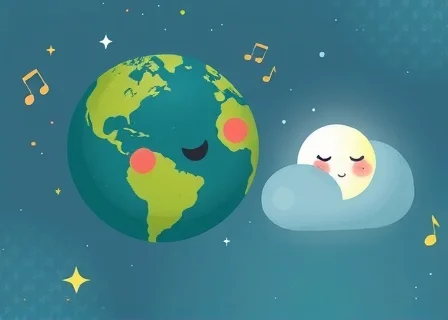
The Earth That Sang a Lullaby to the Moon
# The Earth That Sang a Lullaby to the Moon
Long ago, before time had learned to count itself, the Earth and the Moon were the dearest of companions. While the Sun blazed proudly through the day, showing off its golden crown, the Earth waited patiently for the gentle silver glow of its nocturnal friend. The Moon, shy and luminous, circled the Earth in a dance that had been choreographed by the stars themselves.
But the Moon carried a secret sorrow. Each night, it watched the children of Earth play in the fading light, heard their laughter drift upward like dandelion seeds, and longed to join them. Yet the Moon believed itself too cold, too distant, too pale to be loved. It hid behind clouds when it felt particularly melancholic, and the Earth would ache with worry.
One evening, as the Moon rose particularly wan and tired-looking, the Earth decided it could no longer bear to watch its friend suffer in silence. The Earth gathered all the gentle sounds of its world—the whisper of wind through willow branches, the soft patter of rain on sleeping leaves, the murmur of streams telling ancient stories to smooth stones, the rustle of owls settling into their nests, and the tender hum of mothers singing to their little ones.
The Earth wove these sounds together with the warmth of sun-baked soil and the sweetness of night-blooming jasmine. It created a melody so tender, so full of love, that the stars themselves leaned closer to listen.
"Dear Moon," the Earth rumbled softly, its voice vibrating through mountains and valleys alike, "you who light my darkness, you who pull at my oceans with your invisible hands, you who have never asked for anything but to care for my children—let me sing for you now."
And so the Earth sang. It sang a lullaby made of every comforting sound it had ever known. The song rolled upward in waves of harmony, wrapping around the Moon like a blanket woven from spider silk and starlight. The Moon, surprised by this unexpected gift, began to glow brighter than it ever had before. Its silver light transformed into something warmer, softer—a luminescence born of being truly seen and deeply cherished.
As the lullaby continued, the Moon's sorrow began to melt away, drop by drop, falling to Earth as gentle dew that nourished the morning flowers. The Moon realized that it had never been too cold or too distant—it had simply been waiting to understand that love does not require warmth like the Sun's. The Moon's gift was its gentle constancy, its quiet presence in the darkest hours.
From that night forward, the Earth sang its lullaby whenever the Moon grew weary. Sometimes, if you listen carefully on quiet nights, you can still hear echoes of that ancient song—in the rustling of leaves, in the sighing of waves, in the hush that falls over the world just before dawn. And the Moon, no longer believing itself unloved, shines down with a light that is not borrowed but given freely, a testament to the friendship between a world that sings and a world that listens, forever bound in their celestial dance of care and gratitude.