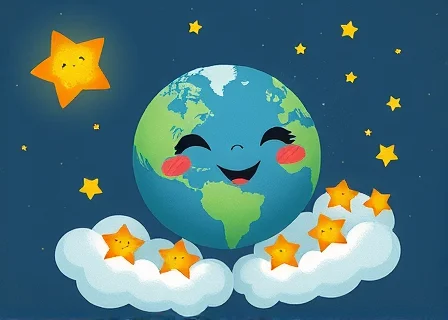
The Earth That Sang a Lullaby to the Stars
# The Earth That Sang a Lullaby to the Stars
Long ago, before time learned to count itself in hours and minutes, the Earth was not the busy, chattering world we know today. She was young and quiet, her forests deep and mysterious, her oceans singing gentle songs against shores of silver sand. But most remarkably, the Earth possessed a voice so beautiful that even the stars would pause in their endless dancing to listen.
Every night, when the moon climbed high above the horizon like a curious child peeking through a window, the Earth would begin her song. It was not a song of words, but of feelings—of roots drinking deeply from dark soil, of winds carrying seeds to new homes, of rivers carving paths through ancient mountains. Her voice rose from every living thing: the rustle of leaves, the whisper of grass, the soft breathing of sleeping creatures in their dens and nests.
The stars, those distant watchers who had seen galaxies born and die, found themselves drawn to this peculiar planet. They had witnessed countless worlds scream in agony or spin in silence, but never before had one sung with such tenderness. Each night they gathered closer, their silver light softening as they listened to the Earth's lullaby.
"Why do you sing to us?" asked the brightest star, one the humans would later call Venus. "We are too far away to keep you warm. We are too old to play with you. We are too many to count."
The Earth's response came through the hooting of an owl and the chirping of crickets. "I sing because you watch over me. I sing because your light guides my children home when they wander in darkness. I sing because even though you are far, you make me feel less alone in this vast universe."
The stars were moved by such wisdom from one so young. They had assumed the Earth sang from loneliness, but instead, she sang from gratitude. From that night forward, the stars made a promise. They would never stop watching over her. They would guide her travelers, mark her seasons, and remind her children that wonder still existed in the world.
As millennia passed, the Earth's song changed. Her children—humans—grew numerous and loud. They built cities that glowed brighter than starlight and machines that roared louder than thunder. The Earth's lullaby became harder to hear, drowned beneath the noise of progress. But she never stopped singing.
To this day, if you find a quiet place far from the humming cities, if you lie on soft grass and close your eyes, you can still hear it. The Earth sings her lullaby through the wind in the trees, through the waves on the shore, through the beating of your own heart. And on the clearest nights, when you look up and see the stars twinkling above, know that they are not merely burning balls of gas, but ancient listeners, still keeping their promise, still leaning close to hear the song of the world that once sang them to sleep.
The Earth still sings. The question is: are we still listening?