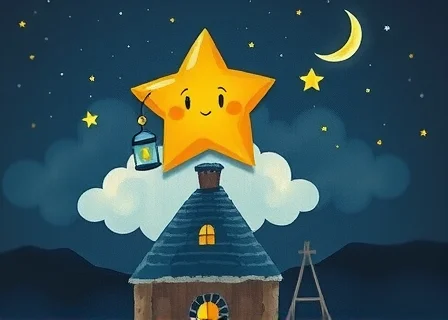
The Evening Star’s Guard Duty
Once upon a time, in the velvet hours between sunset and night, there lived a young star named Lumina who guarded the threshold of evening. She was not like the other stars who sparkled freely across the darkness. Lumina had a duty: she was the first star to appear each evening, the Evening Star herself, and she watched over the world as it slipped from day into dreams.
Long ago, the Moon had chosen her for this sacred task. "The evening is a fragile time," the Moon had whispered, her silver face grave. "Children are afraid of the dark. Travelers lose their way. The boundary between the waking world and the dream realm grows thin. You must guard this hour, little star."
And so Lumina took her post, burning bright in the western sky while the sun's last golden fingers still touched the horizon. She watched over mothers singing lullabies, over fathers locking their doors, over owls stretching their wings for the night's work ahead. She guided the bats from their caves and the fireflies from their leafy hiding places.
But guarding was lonely work. While other stars played games of twinkle and chased comets across the endless dark, Lumina remained fixed in her spot, always the first to arrive, never free to wander. Sometimes she wondered if anyone even noticed her vigil.
One evening, as she performed her lonely watch, Lumina heard a small sound rising from the world below. It was a child, crying in a room with a window facing the sky. The little one had woken from a nightmare and could not find sleep again.
Without thinking, Lumina did something she had never done before. She pulsed her light gently, rhythmically, like a heartbeat made of starshine. Down in the bedroom, the child looked up and saw the steady, comforting glow. The crying slowed. The child's small hand pressed against the windowsill, and Lumina pressed her light against the glass in return.
Night after night, this became their ritual. The child—whose name was Elara—would look for her star, and Lumina would pulse her greeting. Elara stopped fearing the dark. She began to tell the Evening Star all her secrets: her dreams of flying, her worry about starting school, her love for her grandmother's strawberry jam.
And something miraculous happened. Other children began noticing the Evening Star's gentle rhythm. They too started sharing their worries and wishes with Lumina. She realized that her guard duty was not about watching over the world from afar—it was about being present, about being the constant light that said, "You are not alone in the darkness."
The Moon noticed the change. "You have discovered the true nature of guardianship," she said warmly. "To guard is not merely to watch, but to care."
Lumina burned brighter that night than ever before, and her light carried love to every corner of the sleeping world. She was still the first star of evening, still fixed in her post, but she was no longer lonely. She was beloved, and that made all the difference between duty and destiny.
And if you look up on any clear evening, just as the sun says goodbye, you might see her pulsing softly—still keeping watch, still whispering to every child below that the dark is not something to fear, but a gentle blanket woven from starlight and dreams.