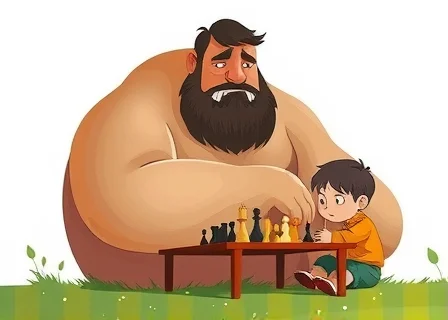
The Giant Who Was a Master of Chess
Once upon a time, in a kingdom nestled between misty mountains and whispering forests, there lived a giant named Thaddeus who stood thirty feet tall and possessed a heart as vast as his stature. But Thaddeus was no ordinary giant. While his kin delighted in crushing castle walls and terrorizing villagers, Thaddeus spent his days hunched over an enormous chessboard carved from ancient oak, each piece the size of a millstone.
Thaddeus had discovered chess when he was merely a youngling of fifty years, stumbling upon a abandoned game in the ruins of a forgotten monastery. Something about the strategic dance of the pieces captivated him. The way a humble pawn could transform into a mighty queen, the sacrificial beauty of a knight's leap, the patient power of a bishop gliding along its colored diagonal—all of it spoke to something deep within his gentle soul.
Word spread through the kingdom of the chess-playing giant, and kings from distant lands journeyed to challenge him. They came with their grandmasters and advisors, certain that their cunning minds would outwit the simple creature. But Thaddeus saw the board differently than any mortal. His great height allowed him to perceive patterns invisible to smaller players—flows of power across the sixty-four squares like rivers of moonlight.
"Checkmate," he would rumble, his voice like distant thunder, as another nobleman's king fell before his strategic might. Yet Thaddeus never gloated. Instead, he would carefully reset the pieces and offer his defeated opponent tea brewed from mountain herbs, served in cups the size of bathtubs.
One autumn evening, a mysterious figure arrived at Thaddeus's cave—a woman cloaked in starlight, her eyes gleaming with ancient knowledge. She introduced herself as Celestia, the Queen of the Night Sky, and challenged the giant to a game unlike any he had played before.
"If you win," she whispered, "I shall grant you any wish your heart desires. But if I triumph, you must leave your mountain home and wander the earth until you find something more precious than chess."
Thaddeus accepted, and they played upon a board made of constellations, the pieces formed from living starlight. The game lasted seven days and seven nights. Pawns became shooting stars; knights galloped along the Milky Way; bishops traced the paths of comets.
On the final move, Thaddeus sacrificed his queen—a brilliant supernova of a piece—to trap Celestia's king in an inescapable web of celestial geometry.
"You have won," Celestia smiled, "though you sacrificed your most powerful piece. What is your wish, noble giant?"
Thaddeus considered his answer carefully. "I wish," he said slowly, "for others to discover the beauty I have found. Teach chess to the children of the kingdom, so they might learn patience, strategy, and the wisdom that sometimes the smallest pieces bring the greatest victories."
And so Celestia granted his wish. Schools opened throughout the land, and children learned the royal game. Thaddeus became their teacher, his massive hands delicately guiding tiny fingers across wooden boards. He discovered that spreading joy was far more satisfying than winning, and that the true checkmate was conquering one's own loneliness.
The giant chess master had finally found something more precious than the game itself: purpose, community, and the laughter of children echoing through his mountain home like the sweetest victory song.