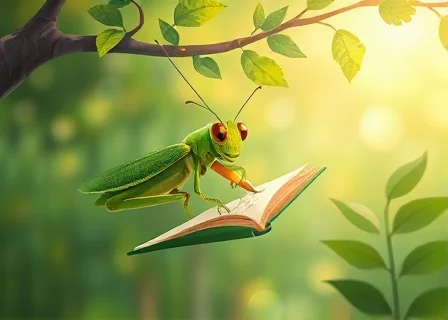
The Grasshopper Who Was a Famous Poet
In a sun-dappled meadow where dewdrops sparkled like scattered diamonds, there lived a grasshopper named Thistle who was unlike any other creature in the kingdom. While his fellow grasshoppers spent their days chirping simple tunes and leaping from blade to blade, Thistle composed verses that made flowers bloom and rivers pause in their flowing.
Thistle's poetry was magic itself. When he recited stanzas beneath the silver moon, the stars leaned closer to listen. His sonnets about autumn's golden breath caused leaves to dance in spirals of amber and crimson. Even the ancient oak trees, who had stood silent for centuries, would rustle their branches in appreciation of his beautiful words.
News of the poet grasshopper spread far beyond the meadow. Butterflies carried whispers of his talent to distant gardens, and dragonflies buzzed tales of his genius across sparkling lakes. Soon, creatures from every corner of the forest began gathering at twilight to hear Thistle's evening recitals.
A wise old owl named Orion, who had witnessed countless seasons come and go, became Thistle's patron and friend. "Your words hold power beyond mere beauty," Orion hooted softly one night. "They weave spells that touch the very soul of nature itself."
But fame brought unexpected challenges. A jealous cricket named Crispin, who once considered himself the finest musician in the meadow, grew bitter at Thistle's renown. One moonless night, Crispin crept to Thistle's favorite composing spot beneath a wildflower and stole his collection of written verses, scattering them into the wind.
When Thistle discovered his life's work drifting away like autumn seeds, his heart ached with profound sorrow. The meadow seemed dimmer, the songs of other insects fell silent, and even the breeze carried a note of mourning.
Yet something remarkable happened. The scattered verses took root in unexpected places. A line about courage found its way to a frightened young mouse, giving her strength to face the shadowy corners of her burrow. A stanza about friendship reached two quarreling squirrels, reminding them of their bond. Verses about hope floated to a wilting garden, where they inspired new growth.
Thistle watched in wonder as his poetry lived on in ways he had never imagined. "Perhaps," he mused to Orion, "the true magic of words isn't in keeping them safe, but in setting them free."
With renewed inspiration, Thistle began composing again, this time sharing his verses more widely. He taught young insects to craft their own stories and poems. He encouraged the chattering brook to find its rhythm and the whispering reeds to discover their rhyme.
Years passed, and Thistle's legend grew beyond the boundaries of any single meadow. Traveling bards sang his verses in distant lands, and parents told their children stories of the grasshopper whose poetry could make the whole world listen.
When Thistle's time finally came to rest beneath the earth, his spirit didn't fade. Instead, it became part of every gentle breeze that carries words of comfort, every sunset that inspires wonder, and every heart that discovers the magic hidden within a perfectly chosen word.
And if you listen carefully on quiet summer evenings, you might still hear the echo of Thistle's verses, whispering through the grass, reminding all who hear that poetry is the soul's way of singing.