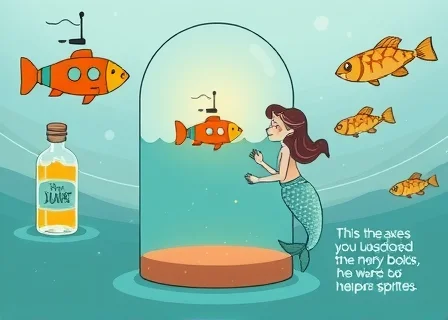
The Little Mermaid and the Deep Sea Lab
# The Little Mermaid and the Deep Sea Lab
Once upon a time, in the crystalline depths of the Azure Trench, lived a little mermaid named Marina. Unlike her sisters who spent their days combing their hair with pearl combs and admiring their reflections in sunlit waters, Marina was fascinated by the strange lights that flickered far below in the abyssal darkness.
The elders spoke of it in hushed tones—the Deep Sea Lab, a mysterious structure built by surface dwellers who sought to understand the ocean's secrets. Some called it a miracle of science; others, an intrusion upon the sacred depths. But Marina felt only curiosity pulling at her heart like a gentle current.
One evening, when the moon painted silver pathways upon the water's surface, Marina swam downward, past the coral gardens, past the whale song meadows, into the twilight zone where bioluminescent creatures danced like living stars. Her tail, iridescent with scales of turquoise and violet, left trails of light in her wake.
As she approached the Deep Sea Lab, she marveled at its glowing windows and humming machinery. Through thick glass portals, she saw humans in white coats peering at screens filled with swirling data and underwater maps. They were studying climate patterns, tracking migration routes, and listening to the songs of creatures she called neighbors.
Marina pressed her palm against the cold glass. Inside, a young scientist named Dr. Elena Ross looked up from her monitors and gasped. For weeks, her instruments had detected unusual acoustic signatures—melodic patterns that defied classification. Now she understood: they were songs of intelligence, of culture, of a civilization hidden beneath the waves.
Their eyes met across the barrier of two worlds.
Night after night, Marina returned. She learned to recognize Elena's silhouette among the crew. She brought gifts: a perfectly spiraled nautilus shell, a fragment of ancient amber, a flower of sea glass polished by centuries of tides. Elena, in turn, left offerings at the lab's outer hatch: books sealed in waterproof cases, recordings of surface music, tiny instruments that could measure water temperature and salinity.
Through their glass wall, they built a friendship that transcended species. Elena showed Marina charts of ocean currents and explained how the lab monitored the health of the seas. Marina sang songs that made the instruments spike with joyous readings, her voice carrying stories of underwater kingdoms, of leviathans older than mountains, of forests of kelp that swayed in eternal dance.
But the surface world grew restless. Ships demanded the lab's relocation. Funding dwindled. The ocean, they said, was too expensive to understand.
On the final night, as the lab prepared to ascend for dismantling, Marina gathered her people. Hundreds of merfolk rose from the depths, their voices joining in a chorus so powerful it registered on every seismograph from Tokyo to San Francisco. News crews broadcast the phenomenon worldwide. The ocean had spoken, and humanity listened.
The Deep Sea Lab remained. And sometimes, on quiet nights when the moon hangs low, sailors swear they can hear two voices harmonizing across the water—one human, one mermaid—singing of friendship deeper than any ocean trench, of understanding that bridges all worlds, and of the magic that blooms when curiosity conquers fear.
Marina never traded her tail for legs, for she discovered something better: she didn't need to leave her world to touch another. She only needed to swim toward the light, and someone on the other side would meet her there.