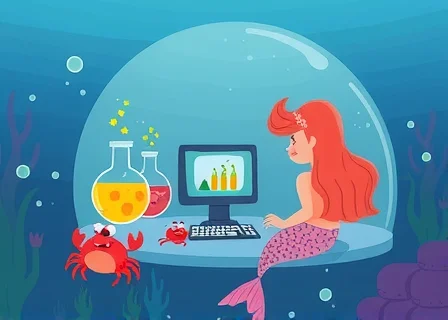
The Little Mermaid and the Underwater Lab
# The Little Mermaid and the Underwater Lab
Deep beneath the sapphire waves, where sunlight fractured into dancing ribbons of gold, lived a little mermaid named Marina. Unlike her sisters who spent their days combing their hair with seashell combs and chasing glittering fish, Marina collected something far more unusual: human treasures that sank to the ocean floor.
Among her collection of compasses, pocket watches, and curious bottles, Marina discovered something extraordinary—a glass sphere that glowed with an inner blue light. Inside floated tiny metal creatures that moved without fins, their gears turning in silent harmony. It was a relic from an underwater laboratory, lost to the sea centuries ago.
The sphere hummed when Marina touched it, and suddenly she could hear whispers in her mind. "Welcome, young scholar," said a voice ancient and kind. "I am Professor Nereus, last keeper of the Atlantis Research Station."
Marina's eyes widened. Atlantis was not merely a myth—it had been real, and its scientists had built laboratories throughout the ocean, studying currents, communicating with whales, and cultivating gardens of bioluminescent coral that could heal any wound.
"Can you show me?" Marina whispered, her tail trembling with excitement.
The sphere pulsed brighter, and the water around them shimmered. A hidden door materialized in the cliffside, covered in symbols that glowed the same blue as the sphere. Marina swam toward it, her heart racing like a dolphin's leap.
Inside, the laboratory was preserved in perfect stillness. Crystal tubes lined the walls, containing swirling liquids of every color. Mechanical seahorses hung from the ceiling, their metal wings folded. In the center stood a great desk made of polished whalebone, upon which rested books bound in kelp leather.
"For three hundred years, this place has waited," Professor Nereus explained, his consciousness living within the sphere. "I sought a student worthy of knowledge—one who values understanding over beauty, curiosity over comfort."
Marina spent days that turned into weeks exploring the laboratory. She learned to read the ancient Atlantean script, discovering recipes for potions that could purify polluted waters. She studied maps showing migration routes of endangered species. She even learned to operate the great telescope that could see through miles of ocean, watching storms form above the surface.
But Marina knew she couldn't keep this wonder hidden forever. The surface world was poisoning the seas—plastics choked the turtles, oil spills darkened the waters, and rising temperatures bleached the coral reefs white as bone.
"Professor," she said one evening, "I must share this knowledge. The humans need to understand what they're destroying."
The old scientist was silent for a long moment. "I feared this day would come. Very well, little mermaid. Take what you need. But remember—knowledge given too quickly becomes weapon rather than remedy."
Marina carefully gathered samples of the healing coral, copies of the purification formulas, and recordings of whale songs that could calm the fiercest storms. She rose to the surface under the light of a full moon and left her treasures where a young human scientist would find them.
Years later, when the oceans began to heal and children played in waters clear as glass, they would tell stories of the little mermaid who bridged two worlds. And deep below, in a glowing laboratory, an ancient professor smiled, knowing his life's work had finally found its purpose.
For magic, Marina discovered, was not in keeping wonders hidden—but in sharing them wisely.