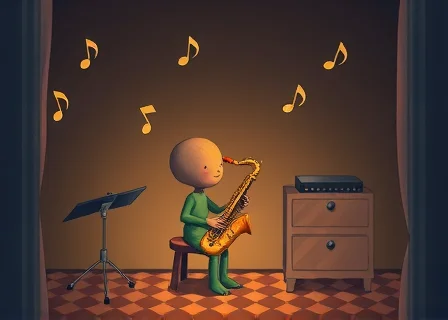
The Martian Who Fell in Love with Jazz
Once upon a time, in the rust-colored valleys of Mars, there lived a Martian named Zephyr who was unlike any of his kind. While other Martians communicated through pulses of light and mathematical equations, Zephyr felt something strange vibrating through the crimson dust—a longing he couldn't name.
One Earth evening, as the blue planet glowed brightly in the Martian sky, a wandering radio signal drifted across the cosmic void. It wasn't the usual data streams or scientific transmissions. It was music. Specifically, it was a saxophone solo from a smoky New Orleans jazz club, recorded decades ago and bouncing accidentally through space.
The notes wrapped around Zephyr's crystalline heart like stardust. He had never felt anything so alive. The saxophone wailed with a loneliness that matched his own, yet somehow transformed that loneliness into something beautiful. Trumpets burst forth like solar flares. The double bass pulsed like the heartbeat of a sleeping planet.
Zephyr became obsessed. He spent his nights tracking the signal's origin, following the jazz like a comet's tail across the galaxy. His fellow Martians warned him. "Emotions are inefficient," they pulsed in their geometric language. "Music is merely vibration. Return to logic."
But Zephyr couldn't return. He had fallen in love.
He built himself a spacecraft from abandoned satellite parts and comet ice, powered by nothing but his determination to find the source of that beautiful sound. The journey took three hundred years by Earth time, though for Zephyr it felt like a single sustained note.
When he finally arrived on Earth, in the city of New Orleans, he was transformed. The Martian crystal had become something warmer, something that could feel the vibration of music in its very atoms. He walked the streets at night, his translucent form shimmering beneath the streetlamps, searching.
Then he heard it—live jazz pouring from a small club called "The Cosmic Note." Inside, an elderly saxophonist named Ella was playing with her eyes closed, her instrument singing songs older than cities. When she opened her eyes and saw Zephyr standing in the doorway, she didn't scream or run. She simply smiled and played a note just for him.
They spent the night talking between songs. Ella explained that jazz was about imperfection, about finding beauty in the unexpected, about listening and responding. Zephyr told her about Mars, about the silence between stars, about how her music had traveled farther than any human sound before.
Zephyr never returned to Mars. He learned to play the vibraphone, his crystalline fingers creating tones no human could produce. Together, Ella and Zephyr became legends in the French Quarter, their music carrying something of both Earth and Mars, of both logic and love.
And sometimes, on quiet nights, when the jazz is particularly sweet and the stars are particularly bright, you can still hear their music drifting through space—a duet between worlds, proving that love, like jazz, is the most universal language of all.