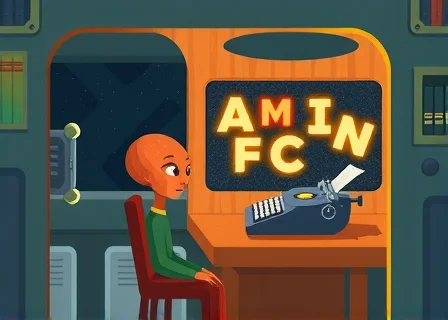
The Martian Who Wanted to Write a Novel
Once upon a time, on the rust-red planet of Mars, there lived a Martian named Zephyr who dreamed of writing a novel. While other Martians spent their days tending to crystalline gardens or communicating through intricate patterns of bioluminescent light, Zephyr would sit by the window of his dome-shaped home, gazing at the distant blue-green star called Earth and wondering about the stories hidden within its swirling clouds.
"You're wasting your time," his neighbor Thalos would say, pulsing a skeptical shade of orange. "Martians don't write novels. We communicate in feelings and light. Words are so... linear."
But Zephyr was undeterred. He had discovered an ancient book in the dusty archives of the Martian Library of Whispers, a relic from a long-forgotten Earth visitor. The book was a collection of fairy tales, and as Zephyr traced his three-fingered hands over the faded pages, he felt something stir within his translucent heart—a longing to create worlds of his own.
Every night, while the rest of his colony slept in their suspended animation pods, Zephyr practiced forming letters with his stylus on sheets of digital parchment. His first attempts were clumsy; his sentences wobbled like newborn foals, and his metaphors crashed like poorly landed spacecraft. But he persisted, driven by an inexplicable magic that seemed to flow from the very atmosphere of Mars itself.
One evening, as the twin moons Phobos and Deimos cast their silvery glow across the desert landscape, Zephyr encountered a mysterious figure at the edge of the crater. It was an elderly Earthling, stranded and forgotten, who had arrived on Mars decades ago during the Great Exploration Era.
"I heard you're trying to write," the Earthling said, her voice crackling through her ancient suit radio.
Zephyr nodded, his antennae flickering with embarrassment. "I want to tell stories, but I don't know if Martians can truly understand human narrative."
The Earthling smiled, her weathered face crinkling like old parchment. "Stories aren't about who tells them, child. They're about the magic that lives between the words—the dreams, the fears, the hopes that connect all conscious beings across the cosmos."
She taught Zephyr the secrets of storytelling: how to build characters that breathe, how to weave conflict like thread through fabric, how to craft endings that satisfy yet linger like the echo of a bell. But most importantly, she taught him that the best stories come from the heart of the teller, from the unique perspective that only they can offer.
Years passed, and Zephyr's novel grew from a collection of awkward sentences into a magnificent tapestry of words. He wrote about Mars as only a Martian could—about the singing sands of the Valles Marineris, about the ice castles that formed at the poles during the long winter nights, about the secret conversations between dust devils dancing across the barren plains.
When the novel was finally complete, Zephyr faced his greatest fear: sharing it with others. Would the other Martians understand? Would they mock his attempt at something so foreign to their nature?
But as he read his first passage aloud at the Gathering of Lights, something miraculous happened. The assembled Martians didn't just hear the words—they felt them. Their bioluminescent skin pulsed with emotions they had never experienced: wonder at the beauty of their own world, joy at recognizing their secret thoughts in another's words, hope that perhaps they too could create something beautiful.
Zephyr's novel became the first book ever written by a Martian, and it inspired a renaissance of creativity across the red planet. Other Martians began to experiment with words, with stories, with the magical act of transforming experience into narrative.
And high above, Earth twinkled like a distant promise, no longer a mystery but a kindred spirit, connected across the vastness of space by the universal language of storytelling.