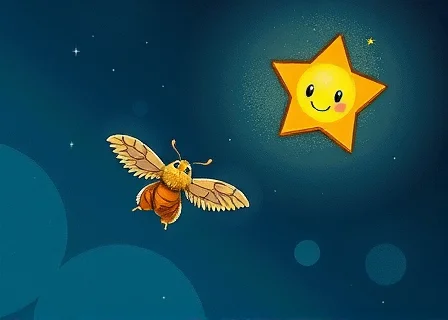
The Moth Who Chased the Evening Star
# The Moth Who Chased the Evening Star
Once upon a time, in a meadow where moonflowers bloomed only on nights of the new moon, there lived a small brown moth named Lumina. Unlike her brothers and sisters, who were content to flutter among the clover and sip nectar from the midnight roses, Lumina harbored a dream that seemed impossible for one so small.
Every evening, as the sun dipped below the western hills and painted the sky in shades of amber and violet, Lumina would emerge from her hiding place beneath a broad oak leaf. She would gaze upward, her compound eyes reflecting the first star that appeared in the twilight sky—the Evening Star, brilliant and golden, promising wonders beyond the meadow.
"Why do you stare at something so far away?" asked her brother Dustwing one night. "There is plenty of nectar here. There are warm breezes and sweet blossoms. What could that distant light possibly offer you?"
Lumina spread her delicate wings, patterned with silver spots that shimmered like tiny mirrors. "I don't know," she confessed, "but I feel that the Evening Star is calling to me. Perhaps it holds a secret meant only for me to discover."
And so, while the other moths danced in circles around the lantern flowers, Lumina began her journey. She flew higher than any moth in her meadow had ever flown. She passed the old owl who nested in the oak tree's highest branches. "Turn back, little one," hooted the owl wisely. "The sky is vast, and you are so small."
But Lumina continued, her wings beating against the cooling air as night deepened around her. She flew past the bat colony that roosted in the nearby cave, their leathery wings creating whispers in the darkness. "Where are you going, foolish moth?" they chattered. "The night belongs to us, not to creatures as fragile as you."
Still, Lumina pressed onward. The meadow became a patch of green far below. The oak tree shrank to the size of a blade of grass. Yet the Evening Star remained just as distant, just as bright, seeming to dance away from her reach.
Hours passed. Lumina's wings grew heavy, and her body tired. She wondered if the owl and the bats had been right. Perhaps she was chasing something she could never catch. Perhaps some dreams were meant to remain dreams.
Just as she considered turning back, a gentle voice spoke from the darkness. "Little moth, why do you chase me?"
Lumina startled. "Evening Star?" she whispered. "You can speak?"
"I can," replied the star, its light pulsing warmly. "And I have been watching you. Many have looked at me with wonder, but you are the first to fly toward me."
"I wanted to know your secret," Lumina admitted. "I wanted to understand why you call to me every evening."
The Evening Star's light softened, surrounding Lumina in a golden embrace. "The secret, dear Lumina, is not in the reaching but in the journey. You have flown farther than you ever imagined. You have seen the world from heights unknown to your kind. You have become braver and stronger than you ever were before."
Lumina realized the star was right. She looked down and saw the meadow, the forest, the winding river, and the mountains beyond—sights no moth had ever witnessed.
"Will you return to your meadow?" asked the Evening Star.
"Yes," Lumina replied, "but I will return changed. I will tell them that the greatest treasures are not found in staying but in seeking."
And so Lumina flew home, carried partway by a gentle starlit breeze. She never stopped looking up at the Evening Star, but she no longer felt the ache of distance. For she understood that some lights are meant to guide us, not to be caught—and that the chasing itself was the magic all along.