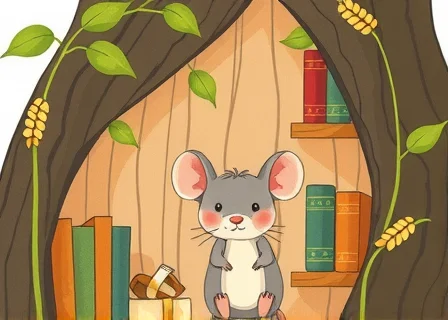
The Mouse Who Built a Library of Grain
# The Mouse Who Built a Library of Grain
In a quiet corner of an ancient barn, where golden shafts of sunlight filtered through weathered wooden slats, lived a small mouse named Thistle. Unlike other mice who spent their days gathering grain for eating, Thistle gathered grain for remembering.
Each kernel held a story, she believed. The plump wheat berries carried tales of summer winds and ripening fields. The slender oats whispered of morning dew and lark songs. The sturdy barley rumbled with stories of thunderstorms and harvest moons.
While her family busied themselves stuffing their cheeks and filling their larders, Thistle carefully arranged her grains in tiny alcoves carved into the barn's oldest beam. She organized them by color, by texture, by the moon phase during which they were gathered. Her collection grew grain by grain, season by season.
"Thistle, dear," her mother would chide gently, "you cannot eat stories when winter comes. You cannot feast on memories when the snow falls deep."
But Thistle would only smile, her whiskers twitching with secret knowledge, and return to her work.
One particularly harsh winter, when ice coated the barn and food grew scarce, a strange thing happened. The barn's resident owl, ancient Orwin who had watched over the farm for seventy years, came seeking shelter from a blizzard. His usual perch in the oak tree had frozen beyond comfort.
Thistle welcomed him warmly, offering what little food she had stored. In gratitude, Orwin asked what occupied the curious alcoves along the beam.
"It is my library," Thistle explained proudly. "Each grain holds a story. Would you like to hear one?"
The owl, skeptical but curious, nodded. Thistle selected a amber kernel of corn and began to tell its tale—of a farmer's laughter, of children playing in the fields, of a summer picnic beneath blue skies.
Orwin listened, mesmerized. When Thistle finished, he blinked his great golden eyes. "Remarkable. I lived through that summer, and every word is true."
Word spread through the barn's inhabitants. The old mare, too lame to leave her stall, requested stories of running free across meadows. The barn cat, grieving her lost kittens, found comfort in tales of playful young cats dancing in haystacks. Even the spiders paused their weaving to listen to grains that told of silk and starlight.
Thistle's library became the heart of the barn, a place where creatures gathered not for food, but for something that fed them more deeply. They shared their own stories in return, and Thistle carefully added new grains to her collection, each one preserving a memory that might otherwise have been lost.
When spring arrived and the barn emptied into the warmth, the creatures left with something more valuable than stored food. They carried hope, connection, and the understanding that stories, like seeds, could be planted in hearts and grow into something beautiful.
Thistle remained in her corner, tending her library of grain, knowing that the smallest creature could build the greatest treasure—not of gold or food, but of remembrance itself. And in that quiet barn, magic lived not in spells or enchantments, but in the simple act of preserving stories, one kernel at a time.