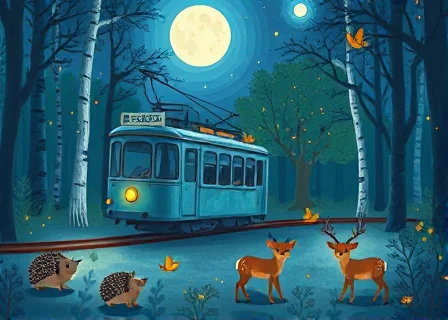
The Old Tram Who Wanted to Go to the Woods
In a cobblestone city where mist curled around lampposts like sleepy cats, there lived an old tram named Tolyan. His paint was the color of faded cornflowers, peeling at the edges like autumn bark. His bell still rang true — *ding-ding* — but his joints ached on rainy days, and his wheels complained with every turn.
For forty-three years, Tolyan had traveled the same route: down Ploshchad Mira, past the bakery with its golden croissants, across the river bridge, and back again. He knew every crack in the rails, every wobble in the overhead wire, every corner where children pressed their noses to shop windows to watch him pass.
But Tolyan dreamed of something else entirely.
Every morning, before his first run, he would gaze past the city limits, where the sky softened into green and the air smelled of pine needles and wild mushrooms. The woods. A vast, breathing forest he had only heard about from the pigeons who nested in his ceiling. They spoke of deer that moved like shadows, of streams that sang over smooth stones, of mushrooms that glowed like tiny lanterns in the dark.
"I carried people my whole life," Tolyan would murmur to the empty depot. "But who will carry me to the woods?"
The other vehicles laughed. The buses, sleek and diesel-proud, honked their amusement. "You're a *tram*," scoffed Number Seven, a young trolleybus with gleaming windows. "You're chained to rails. You go where the tracks take you. That's all you'll ever do."
But Tolyan did not believe that tracks were the same as fate.
One November evening, when the snow began falling like torn paper from a giant's letters, a strange thing happened. The last passengers disembarked. The conductor wound his watch. The city grew quiet, and the tracks ahead seemed to shimmer — not with frost, but with something older. Something magical.
A fox appeared at the edge of the platform. Her coat was the color of burnt sugar, and her eyes held the patience of trees.
"You've been calling," she said simply.
"I — what?" Tolyan's bell rang nervously. *Ding.*
"The forest hears all restless things. Especially those who dream against their nature." She trotted forward, leaving paw prints that steamed in the cold. "Follow me."
"I can't leave the tracks."
"Tonight, the tracks will leave you."
And so Tolyan rolled forward, and something miraculous occurred. Beneath his wheels, the iron rails softened, unspooled, stretched — not into road or dirt, but into something like moonlight made solid. A silver path, humming gently, led out of the city, past the last streetlamps, past the last houses, into the dark and waiting trees.
The forest received him like a long-lost relative. Ancient oaks parted their branches. Ferns curled respectfully away from his wheels. The path wound uphill, then down, through silver birch and black spruce, until it opened into a clearing where fireflies hung in the air like chandeliers in a ballroom.
Creatures gathered — hedgehogs, owls, a badger with spectacles perched on his snout. A deer stepped forward and touched her nose to Tolyan's bumper.
"Thank you for coming," she said. "We have needed a storyteller."
And so Tolyan stayed. He never returned to the city. Each night, the animals climbed aboard his worn velvet seats, and he told them stories of the bakery, the river bridge, the children at the windows. He spoke of human lives — brief, bright, full of rushing and longing — and the animals listened with wide, unblinking eyes.
Sometimes, on very quiet nights, if you stand at the edge of those woods, you can hear it: a soft bell ringing among the trees. *Ding-ding.* A reminder that even the most track-bound soul can find a way into the wild, if the dreaming is deep enough and the fox is kind.