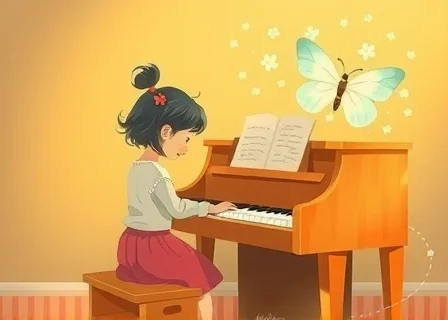
The Piano That Only Played Happy Thoughts
Once upon a time, in a small village nestled between whispering willows and singing streams, there stood a peculiar piano shop. The shop belonged to an elderly instrument maker named Maestro Cornelius, whose fingers had crafted music for over eighty years. But among all his creations, one piano stood apart—painted midnight blue with stars that seemed to twinkle on its surface.
This was no ordinary instrument. The Piano That Only Played Happy Thoughts had been enchanted by a wandering fairy who sought to heal a grieving town. Years ago, the village had lost its joy after a harsh winter took their harvest and their laughter. The fairy, witnessing their sorrow, poured her magic into Cornelius's newest piano, binding it to the purest human emotion: happiness.
The magic worked mysteriously. When someone sad approached the piano, it would remain silent, no matter how hard they pressed the keys. But when a heart light with joy touched its ivory, melodies would pour forth like liquid sunshine, filling the air with tunes that made flowers bloom and birds join in harmony.
Young Lily was the first to discover the piano's gift. She had come to the shop seeking shelter from rain, her pockets full of wildflowers she'd gathered for her sick grandmother. As she waited, her fingers wandered to the blue piano. The moment she thought of her grandmother's smile upon receiving the flowers, the piano sang. A beautiful waltz erupted from its strings, so enchanting that customers stopped their conversations to listen.
News spread quickly through the village. People came from neighboring towns, hoping to hear the magical instrument. But many left disappointed—those carrying anger, jealousy, or grief could not coax even a single note from its depths. The piano demanded authenticity; it could not be fooled by forced smiles or pretended joy.
Maestro Cornelius became wise in reading hearts. He would gently turn away those who came with mockery in their souls. But to the genuinely troubled, he offered counsel. "Happiness is not a destination," he would say, "but a collection of small moments. Find one true moment, and the piano will sing."
A wealthy merchant once arrived, boasting he could make any instrument play. He pressed the keys with confidence, but silence answered him. Frustrated, he returned day after day, growing humbler each visit. Finally, on his seventh attempt, he remembered the laughter of his daughter's first steps. The piano responded with a gentle lullaby, and the merchant wept—not from sadness, but from rediscovering what truly mattered.
Seasons changed, and the piano became a beacon of hope. Couples brought their wedding songs, children brought their games, elders brought their memories. The village flourished, not because troubles disappeared, but because people learned to seek the light within their darkness.
Years later, when Maestro Cornelius passed, the piano fell silent for a full year. The village mourned, fearing the magic had died with its maker. But on the first anniversary of his death, little Lily—now grown—approached the instrument with her own young daughter. She spoke of Cornelius's kindness, of how he had taught them all to find joy in small things.
The piano sang louder than ever before, its melody carrying on the wind to every corner of the valley. And it was said that on quiet evenings, when someone somewhere genuinely smiled, you could still hear its music drifting through the air, reminding all who listened that happiness, once found, never truly fades.