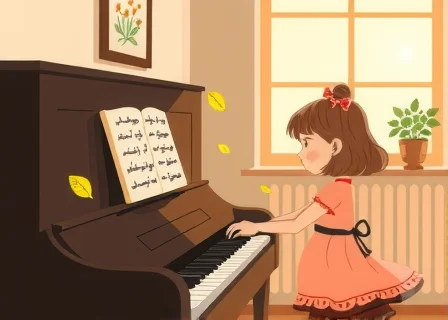
The Piano That Played the Sound of Hope
In a village nestled between whispering willows and silver mountains, there stood an old music shop that no one visited anymore. Its windows were clouded with dust, and its sign creaked lonely songs in the wind. Inside, atop a pedestal of worn oak, sat a piano unlike any other. Its keys shimmered like moonlight on water, and its body was carved from wood that had once been part of a tree growing in the Garden of Dreams.
This was the Piano of Hope, though nobody remembered its name anymore.
The village itself had forgotten what hope felt like. Years of gray skies and empty harvests had turned people's hearts to stone. Children no longer laughed. Musicians had packed away their instruments. Even the birds sang softer, as if afraid to disturb the heavy silence.
One crisp autumn morning, a young girl named Elara discovered the shop's door ajar. She had been chasing a butterfly with wings like stained glass when it fluttered inside. Elara was seven years old, with curious eyes and a spirit that hadn't yet learned to surrender. She stepped through the threshold, and the butterfly landed gently on the piano's keys.
When the butterfly's delicate feet touched ivory, something extraordinary happened. A single note rang out, clear and bright as a morning star. It wasn't just sound—it was warmth spreading through cold bones, it was light breaking through darkness, it was the feeling of remembering something beautiful you thought you'd lost forever.
Elara approached the piano with trembling fingers. She had never played before, but her hands knew what to do. She pressed a key, and the note that emerged carried the sound of her mother's lullaby, though her mother had been gone for years. Tears streamed down her face, but they were not tears of sorrow. They were tears of remembering that joy still existed.
Word spread through the village like wildfire through dry grass. People came reluctantly at first, skeptical and worn. But when Elara played, something shifted inside them. The baker heard the sound of bread rising in warm ovens. The farmer heard rain falling on thirsty fields. The old clockmaker heard his late wife's laughter echoing through time.
One by one, they took their turns at the piano. Each person heard something different, something that spoke directly to their wounded hearts. The piano didn't create false promises or magical solutions. Instead, it played the sound of hope itself—that quiet, persistent voice that whispers "tomorrow might be better" when everything screams otherwise.
As more people played, the village began to transform. Flowers pushed through cracked pavement. Neighbors spoke to each other again. Children's laughter returned, louder than before. The gray skies parted, revealing blue that had been there all along, hidden behind clouds of despair.
Elara became the piano's guardian, though she never owned it. She understood that hope doesn't belong to anyone—it belongs to everyone. The piano remained in the little shop, its door always open, its keys waiting for whoever needed to remember that even in the darkest winter, spring is already on its way.
And if you ever find yourself in a village between whispering willows and silver mountains, listen carefully. You might hear it—that beautiful, impossible sound of hope playing on, forever and always.