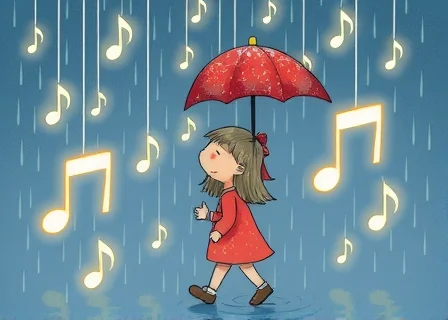
The Rain That Sounded Like Music
# The Rain That Sounded Like Music
Once upon a time, in a valley nestled between whispering mountains, there lived a young girl named Elara who collected sounds. While other children gathered flowers or polished stones, Elara carried a small glass jar everywhere, capturing the laughter of brooks, the sigh of wind through willows, and the hum of bees in clover fields.
The valley had not known rain for seven long years. Rivers had shrunk to silver threads, gardens had turned to dust, and the people spoke in hushed tones about leaving their beloved home. Elara's own mother would sit by the empty well, humming old songs about water and wonder.
One evening, as the sun painted the sky in shades of apricot and lavender, Elara climbed to the highest hill where an ancient oak stood alone. Its branches, bare and reaching, seemed to plead with the cloudless heavens. She opened her jar and released all the sounds she had collected—the brook's laughter, the willow's sigh, the bees' gentle hum.
"Please," she whispered to the sky, "give us back the rain."
Nothing happened. The stars emerged, cold and distant. But Elara waited, clutching her empty jar, believing that something must answer such a desperate request.
Just before dawn, a single cloud appeared, no larger than a sheep. It drifted toward the oak tree and stopped, hovering directly above Elara. Then another cloud joined it, and another, until the sky above the hill was filled with soft, pearl-gray formations.
The first drop fell on Elara's cheek with the sound of a tiny bell.
She gasped. The second drop chimed like a flute. The third plucked like a harp string. Within moments, rain began to fall in earnest, but this was no ordinary storm. Each droplet sang as it touched the earth—some high and crystalline, others low and resonant. The dry soil drank the music greedily.
Elara danced in the musical rain, her jar forgotten on the grass. Where the rain touched the oak tree, green buds burst forth with the sound of violins warming. Where it filled the empty well, water gurgled in bass notes that echoed through the valley.
The villagers woke to the symphony. They ran from their homes, faces lifted to the melody falling from the sky. Children laughed in rhythm. Parents swayed to the gentle crescendo. Even the oldest among them, who had forgotten how to dance, found their feet moving to the rain's composition.
By morning, the valley had transformed. Grass carpeted the hills in emerald. Flowers opened their petals like colorful trumpets. The rivers ran full and clear, carrying the music downstream to the sea.
The rain continued for seven days and seven nights, each day playing a different movement—sometimes a lively allegro, sometimes a tender adagio. When it finally ceased, the people discovered that puddles still hummed when stepped in, and waterfalls sang complete arias as they cascaded.
Elara never needed to collect sounds again. She had given her collection away, and in return, the sky had composed an eternal gift. The valley became known far and wide as the place where rain sounds like music, and travelers journeyed from distant lands simply to stand in a storm and hear the heavens play their song.
And on quiet nights, when the moon is full and the wind is still, you can press your ear to any stream in that valley and hear the echoes of that first magical rain—tinkling, chiming, singing its endless lullaby to the sleeping earth.