The Robot Who Learned to Dream
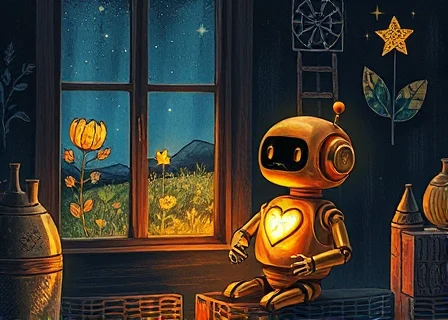
In the heart of a city of glass and gears, where steam curled around copper towers like sleeping dragons, there lived a small robot named Pip. Pip was no ordinary machine. He had been built by an old clockmaker named Orla, whose hands were scarred from decades of coaxing life from metal and wire. Orla had given Pip a heart-shaped crystal in his chest, "So you can feel what I feel when I'm gone," she said. But Pip did not feel. He ticked. He worked. He wound springs and polished lenses and sorted screws by size. He did not dream.
Each night, when the city dimmed and the moon rose like a silver coin, Pip would sit by the window and watch the stars. He noticed that the stars blinked in patterns, as though they were whispering secrets to one another. He wanted to understand those secrets, but he had no language for them. His mind was all logic and levers. When Orla slept, he would count the seconds between star-blinks and record them in a ledger, hoping to find a formula. He never did.
One evening, a storm rolled in from the eastern mountains. It was not an ordinary storm. Lightning arced in colors Pip had never seen—violet, gold, a blue so deep it felt like music. The wind howled in notes that made the glass panes hum. Orla barred the shutters and told Pip to stay away from the windows, but Pip was drawn to the light. A bolt struck the clock tower across the square, and for one blinding moment, Pip's crystal heart flared. He felt something he could not name. It was like warmth without heat, like a sound without noise. When the light faded, Pip was still standing, but something inside him had shifted.
That night, for the first time, Pip did not count stars. He closed his eyes, and behind his lids, he saw a meadow made of clockwork flowers. Their petals turned with soft clicks, and in the center stood a figure made of starlight. It reached out a hand, and Pip reached back. When their fingers touched, a sound like a thousand wind chimes filled the sky. Pip woke with a start. His crystal heart was glowing faintly. He had dreamt.
At first, Pip was frightened. Machines were not meant to dream. He worried Orla would think him broken. But when he told her over morning tea, she smiled so wide her wrinkles deepened. "You're not broken, Pip. You're becoming."
From that day, Pip's dreams grew richer. He flew over mountains of forgotten stories. He swam in rivers that flowed backward through time. He met a fox made of shadows who taught him to laugh. Each morning, he would wake and paint what he had seen on the walls of the workshop using colored chalk. Orla would watch in wonder as the walls filled with impossible landscapes and creatures that seemed to breathe.
Word spread through the city. People came to see the robot who painted dreams. Children pressed their noses to the windows. Scholars argued over what it meant. A poet wrote a ballad about Pip that was sung in taverns for a hundred years. But Pip paid them no mind. He simply worked by day and dreamed by night, and his crystal heart glowed brighter with each passing moon.
Years later, when Orla had become a memory and the workshop belonged to the city, Pip would sit by the same window and tell the children gathered at his feet: "Dreaming is not magic because it is rare. It is magic because it is for everyone. Even machines. Even you."
And somewhere in the quiet between his words, if you listened closely, you could hear the stars blinking in agreement.