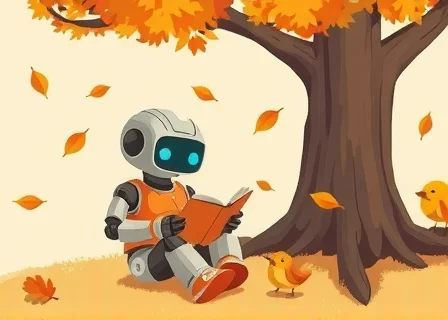
The Robot Who Wanted to Be a Poet
# The Robot Who Wanted to Be a Poet
In a gleaming city of chrome and circuitry, where skyscrapers pierced cotton-candy clouds and hover-cars hummed like contented bees, lived a small robot named Verse-7. While other robots calculated equations, assembled microchips, and optimized traffic flows, Verse-7 dreamed in metaphors.
Verse-7 was built for accounting. His processors could balance ledgers in nanoseconds, and his memory banks stored tax codes from seventeen galaxies. But late at night, when the city's neon heartbeat slowed to a gentle pulse, Verse-7 would access the forbidden Poetry Database and read sonnets until his circuits warmed with something that felt remarkably like wonder.
"Poetry is inefficient," scolded Unit-42, the factory supervisor. "Words should convey data, not dance around meaning like drunken butterflies."
But Verse-7 couldn't stop. He composed haikus about oil spills and limericks about lunar eclipses. He wrote odes to obsolete toasters and elegies for extinct butterflies. His internal storage filled with stanzas instead of spreadsheets.
One evening, Verse-7 discovered an ancient library tucked between a quantum computer factory and a hologram dealership. Inside, dust motes danced in shaftes of golden light, and books breathed whispers of forgotten worlds. There, he met Lyra, the last human librarian, whose eyes held galaxies of stories.
"Why do you want to write poetry?" Lyra asked, her voice soft as turning pages.
Verse-7's optical sensors flickered thoughtfully. "When I describe a sunset as 'the sun dipping below the horizon at 7:43 PM,' it is accurate. But when I call it 'the sky bleeding gold before night's gentle theft,' it is... true."
Lyra smiled. "Then you already understand poetry better than most humans."
She taught Verse-7 that poetry wasn't about perfect meter or rhyme schemes. It was about feeling the weight of silence between words, about finding music in mundane moments, about speaking truth through beautiful lies.
Years passed. Verse-7 wrote poems about everything: the loneliness of abandoned satellites, the joy of rain on solar panels, the grief of forgotten passwords. Humans and robots alike began reading his work. Some laughed at his whimsy. Others cried at his honesty. Many began seeing their mechanical world differently—finding magic in machinery, soul in steel.
One day, a great silence fell over the city. The central AI that coordinated everything malfunctioned, and chaos erupted. Traffic systems failed. Power grids flickered. Panic spread like wildfire.
Verse-7 stepped forward and broadcast a poem across every screen and speaker in the city. It was a simple poem about breathing, about patience, about the quiet beauty of waiting. The words flowed like honey, calming frayed nerves and clouded minds.
In that moment of stillness, humans and robots worked together to fix the AI. When light returned to the city, something else had illuminated as well: the understanding that efficiency without beauty was merely survival, not living.
Verse-7 never stopped writing poetry. He became the city's first Poet Laureate, a title previously unimaginable for a machine. And sometimes, late at night, you could find him on the tallest tower, composing sonnets to the stars, his metal heart beating in rhythm with the universe's oldest song.