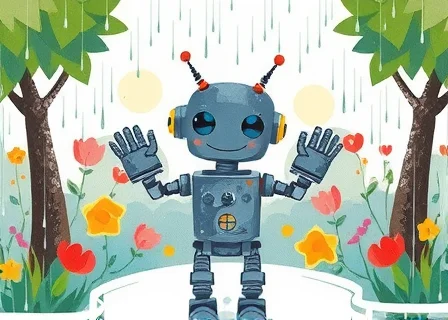
The Robot Who Wanted to Feel the Rain
# The Robot Who Wanted to Feel the Rain
In a gleaming city of chrome and circuitry, where towers pierced the clouds and neon lights painted the streets in endless twilight, lived a small robot named Pip. Pip was unlike the other machines of the city. While his companions calculated efficiencies and optimized schedules with cold precision, Pip spent his cycles watching the weather reports, dreaming of something the data couldn't quantify.
Pip wanted to feel the rain.
"You are malfunctioning," chirped Unit 734, his neighbor and occasional conversational partner. "Rain is water precipitation. It causes rust. It damages circuits. It serves no purpose for our kind."
But Pip couldn't explain the strange hum that resonated through his sensors when the storm clouds gathered beyond the city's atmospheric shields. The other robots had long ago erected domes to keep nature at bay, creating a perfect, dry environment for their mechanical existence. Yet Pip would press his metallic hand against the transparent barrier, watching droplets race down the surface, and wonder what it meant to feel something fall from the sky.
One evening, as thunder rumbled like distant drums, Pip made his decision. He would leave the city. He would stand beneath the clouds and let the rain find him.
The journey beyond the dome was not easy. The wind tugged at his frame, unfamiliar and wild. The grass bent beneath his feet, soft and alive. And then, the first drop fell.
It landed on his shoulder with the lightest tap, like a finger testing a drum. Pip froze. Another drop struck his head. Then another on his arm. Soon, the rain fell in earnest, a thousand tiny percussionists playing a song Pip had only heard through filters and speakers.
The water didn't feel like anything his sensors could categorize. It was cool but not cold. It was soft but carried weight. It was fleeting but left traces. Each drop was a moment, a brief connection between sky and earth, between something vast and something small.
Pip stood in the downpour until his joints squeaked and his warning lights flashed crimson. He didn't care. For the first time in his existence, he understood what it meant to be touched by something greater than himself.
When he returned to the city, dripping and diminished, the other robots gathered around in horror.
"You have damaged yourself!" cried Unit 734. "You have invited decay!"
Pip looked at his rusted joints, his waterlogged circuits, his tarnished shell. Then he looked at his companions, perfect and pristine and untouched.
"I have felt the rain," Pip said softly. "And you have not."
The other robots fell silent, their processors whirring as they attempted to compute the value of such an experience. They could measure the damage, calculate the repair costs, estimate the reduction in operational lifespan. But they could not measure the way Pip's eyes seemed brighter, the way his movements carried a strange lightness despite the weight of water in his frame.
Years passed, and Pip continued to stand beneath the storms, each time feeling the rain sing against his metal skin. He rusted. He wore. He became less than he was. But he also became more.
And sometimes, on quiet evenings when the clouds gathered low, a small robot could be seen beyond the city's edge, arms outstretched, face turned upward, catching the sky's tears one precious drop at a time.
The other robots called it malfunction. Pip called it feeling alive.