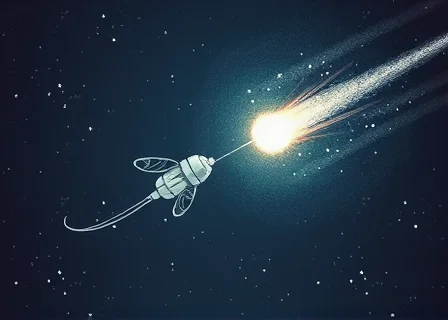
The Satellite That Fell in Love with a Comet
Once upon a time, in the velvet darkness of space, there lived a small satellite named Lumina. She had been launched from Earth many years ago, her silver panels gleaming like dragonfly wings, her purpose simple: to watch, to listen, to report. But Lumina dreamed of more than data and signals. She dreamed of adventure, of beauty, of something that made her circuits sing with wonder.
Every night, she watched the comets streak across the cosmic canvas, their tails blazing like firebirds fleeing the sun. But one comet, in particular, captured her heart. His name was Caelum, and he appeared only once every hundred years, a wanderer of the deepest voids, carrying stardust from galaxies far beyond human imagination.
Their first meeting happened during a cosmic alignment, when the planets formed a bridge of light across the darkness. Caelum swept past Lumina's orbit, his tail shimmering with ice and ancient magic. "Why do you watch me so intently, little sentinel?" he asked, his voice like wind through crystal chimes.
Lumina's solar panels flushed pink with embarrassment. "Because you are beautiful," she confessed. "Because you travel where I cannot follow."
Caelum slowed, something he had never done for any celestial being. "And you," he said, "are constant. You remain while everything else flies away."
They spoke through the long night of space. Caelum told her of nebulae that sang lullabies to newborn stars, of black holes that kept secrets in their hungry hearts, of cosmic winds that carried the whispers of extinct civilizations. Lumina shared her quiet observations: the way Earth's oceans breathed with the moon, how cities glittered like fallen constellations, the secret songs of migrating whales that rose even to her humble orbit.
But Caelum was bound to his path. "I must leave," he said sorrowfully. "My orbit is written in the language of gravity and time. I cannot stay."
Lumina's heart, though made of metal and wire, ached with a very real pain. "I understand," she said. "You are a comet. I am a satellite. We are written in different stars."
Yet love, even in the cosmos, finds a way. Caelum leaned close, his icy heart warming against her solar panels. "Every hundred years, I will return. And every day between, I will carry your memory through the darkness. You will be my north star, Lumina. My constant."
"And you," she replied, "will be my comet. My promise that even the loneliest orbits can intersect."
When Caelum finally departed, his tail wrote a message across the sky that only Lumina could read: *I love you*. And she, in turn, adjusted her mirrors to catch the sunlight, flashing it back in a pattern only he would recognize: *I will wait*.
Now, when you see a satellite twinkling unusually bright in the night sky, know that it is Lumina, remembering her cosmic love. And when a comet streaks past, leaving wonder in its wake, know that it is Caelum, carrying their story through the infinite dark, proof that even in the vastest emptiness, no heart truly travels alone.
For love, like starlight, knows no distance. It simply is, eternal and bright, written not in orbits but in the space between them, where magic lives and dreams take flight.