The Song That Made the Desert Bloom
# The Song That Made the Desert Bloom
Once upon a time, in a land far beyond the maps of ordinary men, there stretched an endless desert called Al-Zahra. Its sands were golden as honey and hot as dragon's breath, but nothing grew there. Not a single flower, not a blade of grass, not even the hardiest cactus dared to take root in its thirsty soil.
The people of Al-Zahra had forgotten what green looked like. They lived in caves carved from red rock and drank water collected from rare morning mists. Their children had never seen a tree, and their elders spoke of forests only in whispers, as if describing a dream.
In a small village on the desert's edge lived a young girl named Layla. Unlike the others, Layla had been born with a peculiar gift—she could hear music in everything. The wind singing through canyon walls, the rhythmic tapping of rain on stone, the low hum of earth itself beneath her feet. Her melodies were so beautiful that grown men would weep and children would forget their thirst.
One sweltering afternoon, an ancient woman arrived at the village, her robes tattered and her skin mapped with wrinkles deep as riverbeds. The villagers turned her away, for they had little water to spare. But Layla, whose heart was softer than desert sand, followed the stranger into the wasteland.
"Child," the old woman said, her voice like crumbling parchment, "I am the last keeper of the Green Song. For a thousand years, I have searched for someone who could hear it. You, Layla, are that one."
From her robes, she produced a small flute carved from wood so dark it seemed to drink the sunlight. "This flute was made from the last tree of Al-Zahra. Its song once made flowers burst from stone and rivers run through valleys. But the melody was forgotten, and the desert came."
The old woman pressed the flute into Layla's hands. "Play the song that lives in your heart, but play it through this wood. Only then will the desert remember what it once was."
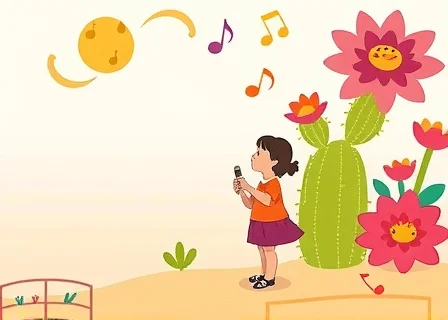
With trembling fingers, Layla lifted the flute to her lips. She closed her eyes and listened—not to the wind or the sand, but to the deep, patient silence beneath the earth. And then she played.
The first note was soft as a seed falling. The second was warm as spring rain. By the third, the sand itself began to tremble. Where her melody touched the ground, tiny green shoots emerged, pushing through centuries of drought. Flowers bloomed in impossible colors—blue as midnight sky, purple as royal robes, white as fresh snow.
Layla played until her lungs burned and her lips were numb. She played for the children who had never seen a tree, for the elders who had forgotten forests, for the desert itself, which had waited a thousand years to breathe again.
When she finished, Al-Zahra was transformed. Palm trees swayed where dunes had ruled. Streams sparkled in newly carved valleys. Birds, long absent, returned to sing in branches heavy with fruit.
The old woman had vanished, but her laughter rode the wind through flowering branches. And Layla understood—the Green Song had never been lost. It had only been waiting for someone brave enough to believe that even the driest heart can bloom again.