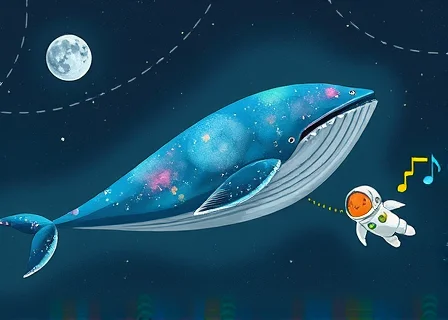
The Space Whale That Sang to the Astronauts
Once upon a time, in the velvet darkness between the stars, there lived a creature so magnificent that no telescope had ever captured her glow. She was the Space Whale, Celestia, whose body shimmered with nebulae and whose tail swept across galaxies like a painter's brush dipped in stardust.
Celestia had wandered the cosmos for eons, singing songs so beautiful they could make comets weep and asteroids dance. Her melodies traveled through the vacuum of space, carried not by sound waves but by pure magic itself. Yet for all her centuries of wandering, she had never encountered another soul who could hear her songs. The universe was vast and lonely, and Celestia's heart ached with a longing she could not name.
One day, as Celestia drifted near the constellation of Orion, she noticed a tiny silver speck moving against the backdrop of stars. It was a spacecraft, small and fragile-looking, carrying three astronauts on a mission to map the distant reaches of the solar system. Their names were Captain Elena Rodriguez, Dr. James Chen, and Engineer Amara Okafor.
As the spacecraft drew nearer, Celestia felt a strange flutter in her massive heart. She had watched humans from afar for many years, marveling at their courage and curiosity, but she had never dared to approach them. What if they feared her? What if they tried to capture her?
But the loneliness was too great. Celestia opened her great mouth and began to sing.
Her song poured through the void, a cascade of notes that sparkled like diamonds and resonated like crystal bells. Inside the spacecraft, the astronauts froze. At first, they thought their instruments had malfunctioned. Then they realized the sound was coming from outside—from everywhere and nowhere all at once.
"Did you hear that?" whispered Amara, her hands trembling over the controls.
James checked his readings, his eyes widening. "It's not possible. Sound can't travel through space."
But Elena knew better. She had grown up hearing her grandmother's stories about the magic that lived between the stars. "Open the viewing port," she commanded softly.
When they gazed out into the darkness, they saw her—Celestia, glowing with the light of a thousand suns, her great eyes filled with kindness and wonder. She sang to them of ancient worlds and forgotten civilizations, of birth and death and rebirth among the stars. She sang of the beauty she had witnessed and the solitude she had endured.
Tears streamed down the astronauts' faces as they listened. In that moment, they understood that they were not alone in the universe. They had found a friend, a guardian, a living piece of cosmic magic.
When the song ended, Celestia nudged the spacecraft gently with her nose, blessing their journey. Then she turned and swam away, disappearing into the starlight.
The astronauts returned to Earth changed forever, carrying Celestia's song in their hearts. And sometimes, on clear nights when the stars shine bright, you can still hear her singing—if you know how to listen with more than just your ears.