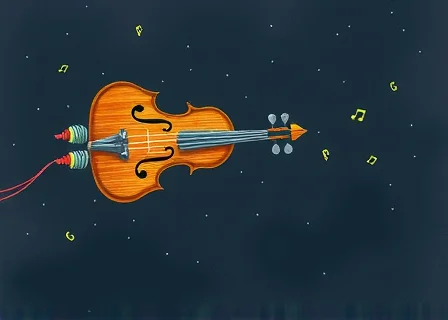
The Spaceship That Looked Like a Flying Violin
Once upon a time, in a kingdom nestled between the clouds and the stars, there existed a most extraordinary vessel known as the Melodia. Unlike any ship ever crafted by human hands, the Melodia resembled a great flying violin, its hull carved from moonwood that shimmered with pearlescent hues, and its four strings stretched taut across the length of its body, humming softly even in stillness.
The Melodia had no captain, no crew, no engines that roared with fire. Instead, it traveled on music. When the wind kissed its strings, they sang notes so pure that space itself bent to their melody, opening pathways through the cosmos that no other vessel could follow. The ship's bow was made of starlight, and when drawn across the strings by invisible hands, it could compose entire symphonies that painted nebulas in shades of violet and gold.
In the kingdom below, there lived a young girl named Lyra who could hear the Melodia's song when no one else could. Every night, she would climb to the highest tower of her family's cottage and listen as the violin-ship sailed overhead, leaving trails of musical notes that sparkled like fireflies before dissolving into the dawn.
One evening, as the twin moons rose in harmony, the Melodia descended lower than it ever had before. Its shadow fell across Lyra's garden, and the strings vibrated with such intensity that the flowers began to dance, their petals swaying to rhythms older than time itself. A voice, gentle as a lullaby, called out to her.
"Lyra," it whispered through the wind, "the universe has lost its song. Will you help us find it?"
Without hesitation, though her heart trembled like a plucked string, Lyra stepped aboard the Melodia. The deck warmed beneath her feet, welcoming her home. As she touched the great strings, visions flooded her mind: galaxies singing in chorus, planets humming their orbital songs, stars crooning lullabies to their newborn worlds. But somewhere in the cosmic symphony, a note had gone silent, and without it, the music would fade forever.
The Melodia soared upward, breaking through the atmosphere into the velvet darkness beyond. Lyra learned to guide the ship by thinking of melodies, her intentions shaping the music that propelled them forward. They danced through asteroid belts that chimed like crystal wind chimes, past comets that whistled ancient folk songs, and into the heart of a nebula where the missing note had been trapped by the Silence—a creature made of nothingness, hungry to consume all sound.
Lyra understood then that the Silence could not be fought with weapons or strength. Instead, she drew the starlight bow across the strings herself, pouring every memory of music she had ever known into a single, perfect note. It was the sound of her mother's laughter, of rain on rooftops, of bees in summer flowers, of the Melodia's first flight.
The Silence shattered like glass, and the missing note flew free, rejoining the cosmic symphony. The Melodia sang triumphantly, its body glowing with renewed brilliance. When Lyra returned home, she carried a small piece of the ship's music in her heart, and ever after, wherever she walked, flowers bloomed in time to melodies only she could hear.
And high above, the Melodia continues to sail, waiting for the next soul brave enough to listen, to dream, to play.