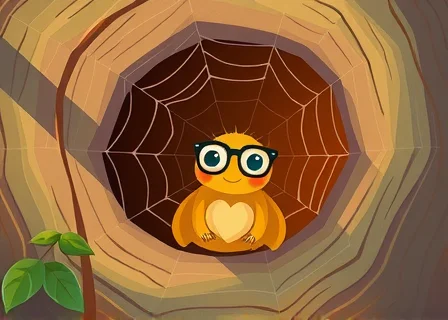
The Spider Who Studied the Geometry of the Web
In the heart of the Enchanted Forest, where moonlight filtered through leaves like silver coins through fingers, lived a spider named Arachne. Unlike her kin, who spun webs by instinct and inherited wisdom, Arachne was consumed by curiosity. She did not merely weave; she wondered why she wove as she did.
Each morning, while other spiders hunted, Arachne studied. She measured the angles where her threads met with dewdrop lenses that magnified the world into crystalline geometry. She discovered that her radial threads always formed perfect isosceles triangles, their bases creating polygons of remarkable regularity. The spiral threads, she noted, maintained equidistant spacing, as if guided by an invisible compass.
"Why do we build this way?" asked her sister Thistle one misty dawn.
"Because it is strong," Arachne replied, tracing a line with her delicate leg. "But there is more. The web is not just a trap—it is a language written in silk and angles."
The forest creatures mocked her. The beetles called her "the philosopher," rolling their eyes. The flies buzzed about her "pointless calculations." Even the wise old owl hooted that geometry would not fill an empty belly.
But Arachne persisted.
She discovered that the golden ratio appeared in her spirals, the same proportion found in seashells and sunflower seeds. She learned that the tension in each thread distributed weight perfectly, allowing her web to catch prey while remaining nearly invisible. The angles at which threads met the branches were never random—they were calculated to minimize stress and maximize stability.
One autumn evening, a terrible storm swept through the Enchanted Forest. Wind howled like a wounded beast, and rain fell in sheets that threatened to drown the world. The other spiders fled, abandoning their webs to seek shelter in hollow logs and beneath bark.
Arachne remained.
She had been studying the storm's patterns, noting how wind moved in vortices and how raindrops followed parabolic arcs. With careful precision, she reinforced her web according to her calculations, strengthening certain threads while loosening others to allow wind to pass through without destruction.
When dawn broke, the forest lay devastated. The other spiders emerged to find their webs shredded, their homes destroyed. But Arachne's web stood—glistening, intact, a masterpiece of silk and mathematics.
More than that, it had protected the branch beneath it, where a family of caterpillars had sheltered. It had caught not prey, but hope.
The forest creatures gathered in awe. The old owl bowed his head. "You have taught us that wisdom lies not in dismissing the strange among us, but in learning from them."
From that day forward, young spiders studied alongside Arachne, learning that beauty and function were twin threads in the tapestry of existence. They discovered that the universe spoke in patterns, and those who listened could weave miracles.
And Arachne? She continued her studies, for she understood that every answer revealed new questions, and every web—whether spun from silk or thought—was merely a beginning, never an end.