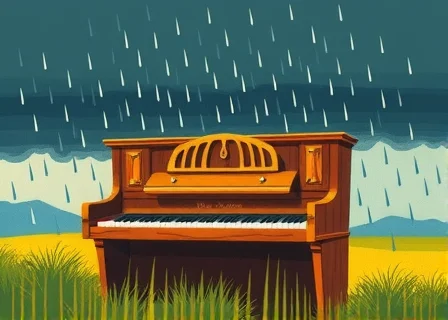
The Storm That Played the Piano
# The Storm That Played the Piano
In the small village of Melodia, nestled between whispering hills and silver streams, there stood an old piano shop that nobody visited anymore. The shop belonged to an elderly man named Maestro Cornelius, who had spent sixty years tuning instruments that no one played.
One humid afternoon, the sky turned the color of bruised plums. The birds fell silent. The wind held its breath. And then, the storm arrived—not with thunder, but with music.
It began as a low hum, like a cello's deepest string. The storm clouds swirled above the piano shop, and lightning didn't crack; it chimed, striking the air in perfect fifths. Rain fell not in drops but in arpeggios, each one landing on the roof with the precision of a pianist's scale.
Maestro Cornelius looked up from his workbench, his spectacles sliding down his nose. "Well," he whispered, "this is new."
The storm pressed against the shop's windows, and somehow, impossibly, it slipped inside. It coiled around the grand piano in the corner—a beautiful instrument made of moonlit oak that Cornelius had been restoring for decades. The storm's essence, electric and alive, settled onto the keys.
And then it played.
The first note was soft, tentative, like a child testing the waters of a dream. The storm played a melody that had never existed before—a song of wind through mountain passes, of rain on ancient forests, of lightning dancing across endless skies. It played the loneliness of clouds drifting forever, the joy of thunder rolling free, the sorrow of storms that must always move, never staying.
Cornelius sat on his worn stool and listened. Tears traced paths down his weathered cheeks. In all his years of tuning, of perfecting, of bringing instruments to life, he had never heard music so true.
The village gathered outside the shop, drawn by the impossible concert. Farmers dropped their scythes. Children stopped their games. The baker forgot his bread. They stood in the gentle rain and listened to the storm play its heart out on the old piano.
Some said they heard their childhood lullabies woven into the melody. Others claimed the storm played songs of their deepest hopes, their secret fears, their unspoken loves. The music knew them all, understood them all, forgave them all.
When dawn approached, the storm's song grew softer, slower. The final chord hung in the air like mist over a morning lake, trembling, beautiful, unfinished.
Then silence.
The storm was gone. The piano sat quiet, its keys still warm.
But something had changed. From that day forward, anyone who sat at that piano could play with the storm's gift. Their fingers would move with wind's grace, their music would carry thunder's power, their melodies would rain down on listeners like blessing.
Maestro Cornelius never restored another instrument. He didn't need to. The village of Melodia became known far and wide as the place where music lived in the very air, where children learned to play by listening to the wind, where every song carried a little bit of magic.
And sometimes, on humid afternoons when the sky turned the color of bruised plums, the villagers would swear they could hear the storm's melody echoing through the hills, waiting to play again.