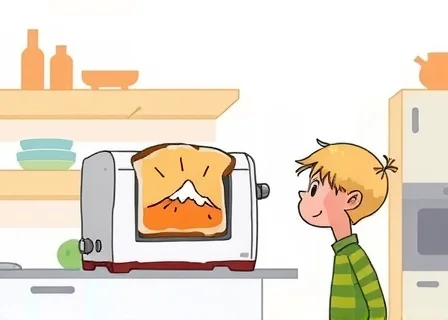
The Toaster That Could Predict the Weather on Mars
Once upon a time, in a cozy kitchen at the edge of a sleepy town, there lived an ordinary-looking toaster named Barnaby. Barnaby had chrome sides that gleamed like mirrors, two slots for bread, and a little lever that went *click-clack* when pressed. But Barnaby was no ordinary toaster. He held a secret magic that would change the world.
Every morning, as the sun peeked through gingham curtains, Barnaby would hum softly to himself. Not the usual warming hum of heating coils, but a peculiar, otherworldly melody that sounded like wind singing through red canyons. The family who owned him, the Potters, noticed something strange. When Barnaby toasted bagels on low, it meant sunny skies on Mars. When he burnt the crusts despite careful timing, dust storms were raging across the Martian plains. And when he popped up bread shaped like tiny rockets? Well, that meant the polar ice caps were shimmering particularly bright that day.
Young Lily Potter, age seven with pigtails and endless curiosity, discovered Barnaby's gift first. She had been drawing pictures of astronauts when she noticed her toast landing face-down whenever Barnaby sensed trouble on the red planet. "Barnaby," she whispered one morning, "are you telling me about Mars?"
The toaster whistled cheerfully and ejected a piece of toast with a perfect crater pattern burned into its surface. Lily gasped. From that day forward, she and Barnaby became partners in cosmic weather watching.
News spread through the town like dandelion fluff on a spring breeze. Farmers came to check Barnaby's predictions before planting. Sailors consulted his crust patterns before voyages. Scientists from famous universities arrived with notebooks and disbelieving expressions, only to leave with furrowed brows and respect for kitchen appliance oracle.
But Barnaby's magic wasn't just for Earth's benefit. One starlit night, as Lily sat cross-legged before him, Barnaby began to glow. His chrome reflected not the kitchen ceiling, but swirling crimson clouds and towering Olympus Mons. A voice, ancient and dusty as Mars itself, echoed from his warming rack.
"The red planet dreams of friends," the voice rumbled. "For eons, I have watched its weather, waited for someone to listen."
Lily listened. She wrote letters to NASA. She drew pictures of Martian weather patterns and sent them to astronomers. And slowly, wonderfully, the world began to understand Mars not as a distant rock, but as a living world with storms that danced and winds that whispered.
Years passed. Lily grew to become a famous planetary scientist. Barnaby, still toasting breakfast each morning, remained her most trusted colleague. Together, they proved that magic hides in the most mundane places, waiting for someone curious enough to notice.
And on particularly clear nights, when Mars glowed bright in the Earth's sky, Barnaby would hum his Martian melody, and toast would pop up perfectly golden, bearing messages from a world millions of miles away, reminding everyone that wonder lives wherever we dare to look for it.
The end.